
A single 10,000-pound forklift pivot can destroy standard adhesive in less than three seconds. It’s a frustrating reality for facility managers who see their safety budgets literally peel off the concrete floor within months of application. You already know that shredded tape is more than an eyesore; it is a trip hazard and a direct violation of OSHA 1910.22 standards that can lead to significant fines. Since 1994, StripeGuys has focused on the safety, quality, and communication triad to solve these exact industrial bottlenecks and keep operations running smoothly.
This guide provides the technical roadmap you need to master warehouse floor marking tape selection and installation for 2026. We’ll examine why high-traffic zones require specific mil thickness and how proper surface preparation, such as cleaning away densifier (a chemical floor hardener), determines your long-term ROI. You’ll learn the durability factors that allow for 24/7 operations without the constant disruption of maintenance crews. We will cover everything from adhesive chemistry to the precise layout of paths of egress (safe exit routes) to ensure your facility remains organized, compliant, and efficient for years to come.
Key Takeaways
- Understand how industrial-grade systems support Lean 5S and Six Sigma methodologies to create a more organized, efficient workspace.
- Evaluate the performance trade-offs between epoxy striping and tape, focusing on the zero-downtime advantage of tape in high-traffic forklift environments.
- Identify the critical material specs for warehouse floor marking tape, including why beveled edges are essential for preventing forklift shear.
- Learn the professional “Tamp” process and mechanical cleaning steps necessary to ensure your markings achieve a permanent adhesive bond.
- Gain insights from nearly three decades of field experience to streamline large-scale safety rollouts while maintaining strict OSHA compliance.
Understanding Warehouse Floor Marking Tape Systems
Effective facility management starts with clear visual communication. High-traffic industrial environments require more than standard vinyl tape found in a typical office supply store. Industrial-grade warehouse floor marking tape is engineered with heavy-duty materials like PVC or polyester and backed by aggressive adhesives designed to bond with concrete. This durability is essential because standard tapes fail under the 5,000-pound pressure of a moving forklift. Floor marking tape serves as a critical tool for Lean 5S and Six Sigma methodologies, providing the structure needed to eliminate waste and reduce motion errors. It acts as the first line of defense in warehouse safety by establishing immediate visual boundaries.
Primary functions of these systems include designating paths of egress (unobstructed routes to exits), marking hazard zones, and defining staging areas for palletized goods. Since 1994, StripeGuys has seen how these clear boundaries prevent accidents and streamline logistics. Clear lines tell operators exactly where to drive and where to park, which reduces the mental load on staff. This organized approach ensures that safety isn’t a suggestion but a built-in feature of the floor plan.
OSHA Compliance and Color Standards
Standardization is the core of industrial safety. Following a uniform color code ensures that any worker, regardless of their specific role, understands the environment at a glance. Yellow is the industry standard for traffic lanes and work cells, indicating caution and movement. Red identifies fire-related hazards and the location of emergency equipment like extinguishers. White is used for general storage areas and production racks to distinguish them from active transit paths. OSHA 1910.22 requires that the employer must ensure the load rating for every building or structure is marked on plates and placed in a conspicuous location.
The 5S Framework for Facility Organization
The 5S methodology (Sort, Set in Order, Shine, Standardize, and Sustain) relies on visual cues to maintain efficiency. Tape is most effective during the “Set in Order” phase. It creates permanent homes for tools, trash bins, and heavy machinery, ensuring that every asset has a specific place. This level of organization prevents clutter from accumulating in high-traffic zones. Unlike permanent paint, warehouse floor marking tape offers the flexibility needed for evolving layouts. If a facility expands or changes its workflow, managers can peel and replace lines without the downtime required for grinding and curing paint. This adaptability is vital for maintaining high-profile projects that require constant optimization.
Floor Tape vs. Epoxy Striping: A Performance Breakdown
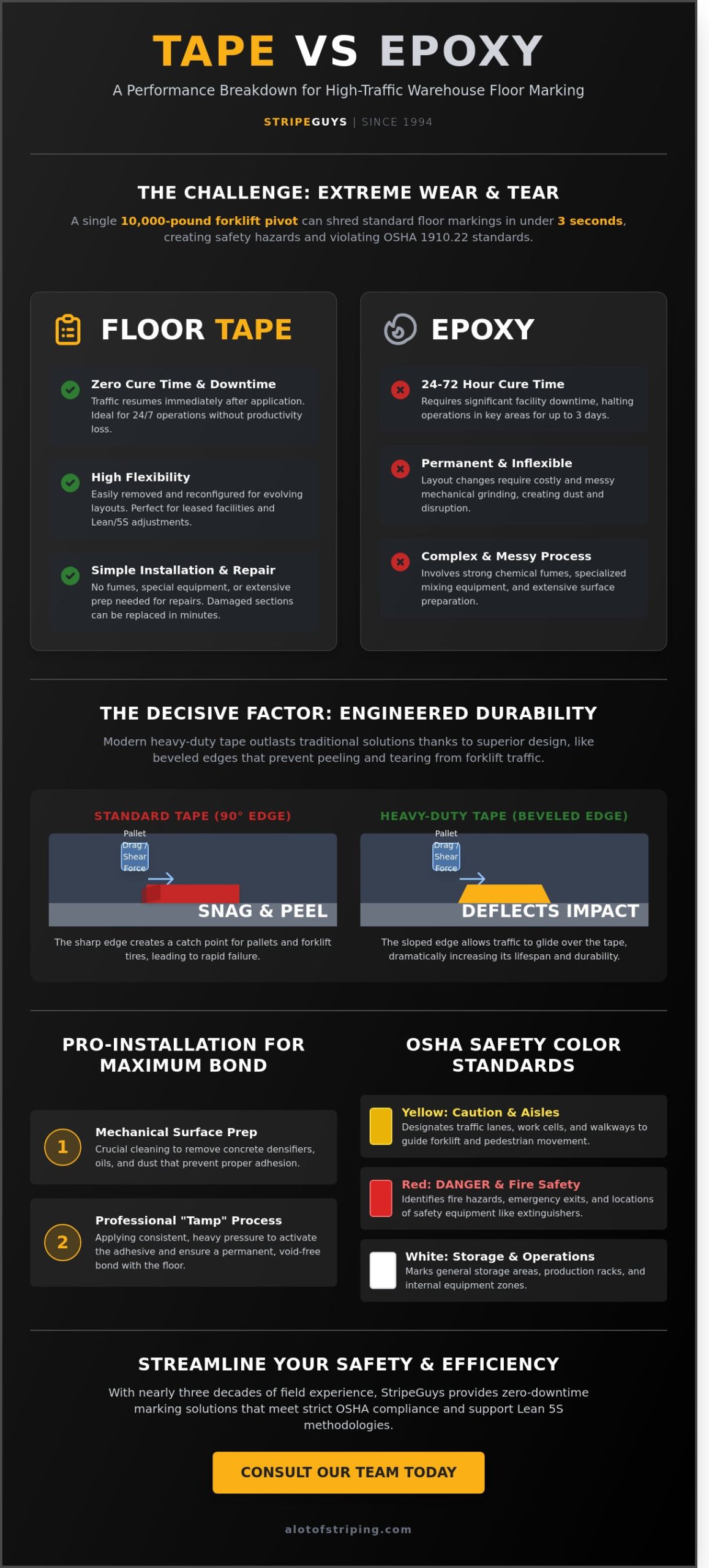
Facility managers often weigh the immediate convenience of warehouse floor marking tape against the perceived permanence of industrial epoxy. The most critical metric in this comparison is cure time. High-grade epoxy systems typically require a 24 to 72 hour window for full chemical bonding and hardening. This translates to three full days of lost productivity in high-volume distribution centers. In contrast, adhesive solutions offer zero cure time. Traffic resumes the moment the backing is removed and the material is applied to the slab. Since 1994, we’ve seen how these operational delays impact the bottom line of 24/7 facilities.
Durability in 10,000-pound forklift environments is a common concern. While epoxy is traditionally tougher, modern heavy-duty tapes are engineered with beveled edges to resist pallet drag and shear force. If you need help deciding which path fits your specific slab, you can consult with our team to evaluate your facility traffic patterns. Initial investment for tape is often higher per linear foot, but the long-term maintenance costs stay low because you don’t need specialized equipment for repairs.
When to Choose Adhesive Markings
Adhesive solutions are the standard for leased facilities where permanent paint or epoxy is prohibited by property management. They’re also the preferred choice for facilities requiring frequent layout adjustments. Data suggests that 35% of modern logistics hubs reconfigure their floor plans annually to accommodate new SKUs. Tape allows for these changes without the mess of grinding. For urgent safety audits, tape is the fastest way to align with OSHA floor marking requirements, ensuring paths of egress are clearly defined before an inspector arrives.
The Limitations of Traditional Paint
Traditional paint often fails under heavy pallet traffic, leading to fading and chipping within six months of application. This creates a cycle of constant repainting that disrupts workflow. In food-grade or pharmaceutical hubs, fumes and VOC (volatile organic compound) concerns make epoxy application difficult without expensive ventilation setups. Furthermore, epoxy requires diamond grinding (roughing up the smooth surface) to ensure a proper bond. This mechanical preparation is loud, creates significant dust, and adds a substantial labor cost to the project. Without this intensive prep, paint will peel away from the concrete densifier, leading to a failed safety system that requires a total redo.
Selecting the Right Material for High-Traffic Environments
Durability in a busy facility depends on how the material interacts with daily forklift traffic. Many managers assume that a thicker warehouse floor marking tape is automatically more durable, but thickness can be a liability. A 50-mil tape with a blunt, square edge presents a vertical obstacle for the 5,000-pound chassis of a moving forklift. This leads to “shear,” where the pallet jack or lift forks catch the edge and tear the material from the substrate. StripeGuys recommends beveled-edge tapes (sloping the sides of the tape) because they allow wheels to roll over the surface rather than impacting it directly. This simple geometric shift can increase the lifespan of your markings by 300% in high-turnover zones.
Adhesive chemistry is the second pillar of a successful installation. We typically choose between two primary types based on the environment:
- Rubber-based adhesives: These provide a high initial “tack” and are ideal for standard concrete. They bond immediately, allowing for instant traffic.
- Acrylic-based adhesives: These require a curing period but offer superior resistance to chemical spills and UV exposure. They’re the standard for facilities handling oils or solvents.
Specialty tapes extend functionality beyond simple organization. Reflective tapes improve visibility in dimly lit areas, while anti-slip tapes (incorporating a grit surface) are essential for loading docks where moisture is present. For emergency paths of egress, photoluminescent tapes provide a “glow-in-the-dark” fail-safe that remains visible during power outages, ensuring your team can find exits safely.
Heavy-Duty and Freezer Grade Options
Standard adhesives often crystallize and fail when temperatures drop below 32°F. For cold storage and blast freezers, we utilize specialized freezer-grade warehouse floor marking tape designed to bond at temperatures as low as -20°F. These materials often feature a reinforced polyester backing to resist the extreme impact of heavy machinery in brittle, cold environments. In manufacturing labs, we prioritize chemical-resistant topcoats that prevent the pigment from leaching when exposed to caustic cleaning agents.
Surface Compatibility and Concrete Profiling
The success of any tape depends on the concrete profile (the texture of the floor). Polished concrete with a high-gloss finish often lacks the “teeth” needed for a mechanical bond. If your facility uses densifiers (chemical hardeners like lithium silicate), the surface pores are sealed, making adhesion difficult. We also look for “sweating slab” syndrome, which occurs when moisture migrates through the slab and collects under the tape. Before application, StripeGuys often performs a calcium chloride test (ASTM F1869) to measure moisture vapor emission rates. This technical rigor ensures we deliver on our triad of safety, quality, and communication, a standard we’ve maintained since 1994.
Professional Installation: Ensuring Maximum Adhesive Bond
Properly installing warehouse floor marking tape isn’t just about sticking a strip to the ground. It’s a technical process that dictates the longevity of your facility’s safety layout. Since 1994, we’ve seen that 90% of tape failures occur because of poor surface preparation rather than the product itself. A successful bond requires a clean, dry, and structurally sound substrate. We prioritize mechanical cleaning to remove old line paint and deep-seated oils that standard sweeping leaves behind. This process ensures the adhesive makes direct contact with the concrete pores.
Environmental controls are equally critical. Most industrial adhesives require a minimum temperature of 50°F to cure correctly. Humidity levels must remain below 80% to prevent moisture from being trapped under the tape. Before application, our teams use chalk lines to establish layout planning with industrial precision. This prevents crooked lines and ensures that paths of egress (emergency exit routes) meet strict compliance standards. Our approach centers on the safety, quality, and communication triad to guarantee a result that withstands heavy forklift traffic.
The Step-by-Step Application Protocol
Consistency is the key to a durable floor. Following a strict protocol ensures that every linear foot of tape performs as expected. Our technicians follow these specific steps:
- Degrease the surface: We use an industrial degreaser like Isopropyl Alcohol (IPA) to strip away microscopic contaminants.
- Apply without tension: You must avoid stretching the tape during application. Stretching creates “snap-back” failure, where the tape pulls away from the ends as it tries to return to its original length.
- The Tamp Process: We use a weighted roller with a minimum 150lb load. This pressure is non-negotiable because it activates the pressure-sensitive adhesive (the glue that hardens under physical weight).
Common Failure Points and How to Avoid Them
Identifying potential hazards before they happen saves on maintenance costs. One major issue is “tenting” over expansion joints. If the tape isn’t cut at every joint, the natural movement of the concrete will pull the tape up, creating an air bubble and a trip hazard. Another frequent mistake is applying warehouse floor marking tape to fresh concrete. New slabs must cure for at least 28 days to allow for outgassing (the release of moisture and vapors). If you apply tape too early, the gases will destroy the adhesive bond within weeks.
Ignoring the manufacturer’s minimum application temperature is a recipe for immediate failure. If the floor is too cold, the adhesive remains brittle and won’t “wet out” into the concrete surface. We ensure all environmental factors are met before the first roll is opened. If you need a team that understands these technical nuances, contact StripeGuys for a professional consultation.
Strategic Safety Planning with StripeGuys
StripeGuys brings nearly three decades of industrial striping expertise to every facility project. Since 1994, our team has focused on delivering functional outcomes for high-stakes environments where precision is non-negotiable. Choosing the right warehouse floor marking tape is just one component of a comprehensive safety strategy. We provide a full suite of services that goes beyond simple lines, integrating novolac epoxy, heavy-duty bollards, and professional line removal via diamond grinding (the process of roughing up the smooth concrete surface to ensure maximum adhesion). Our work is anchored by a steadfast commitment to safety, quality, and communication, ensuring your project stays on schedule and within your established budget.
National Project Management for Logistics Hubs
Logistics managers overseeing regional distribution centers need consistency to ensure employee safety across all locations. We offer national coverage to standardize markings across multiple sites, providing a 100% uniform safety protocol that simplifies training and internal compliance. Our crews prioritize your operational needs by offering night and weekend scheduling, which prevents costly downtime in 24/7 facilities. This consultative approach ensures every project meets OSHA and ADA compliance standards without the facility manager needing to micromanage the details. We’ve successfully executed rollouts for distribution centers exceeding 750,000 square feet, maintaining a brisk and efficient pace that respects the physical realities of high-traffic forklift environments.
Get a Professional Marking Assessment
A professional site survey is the most effective way to prevent the 20% rework rate typically associated with improperly planned DIY applications. Our industrial veterans perform detailed assessments to determine if warehouse floor marking tape or a more permanent epoxy solution is best for your specific floor density and traffic patterns. We handle complex requirements like specialized path of egress planning and custom stenciling for hazardous material zones. We also evaluate the need for a densifier (a chemical sealer that hardens the concrete surface) to ensure your markings last as long as possible. By identifying potential issues before the first line is laid, we save you time and administrative stress. Contact the industrial veterans at StripeGuys for a facility walkthrough to start your project with a partner who has led the industry for nearly 30 years.
Optimize Your Industrial Workflow with Precision Striping
Selecting the right warehouse floor marking tape is a critical decision for any facility manager aiming to reduce logistical stress and improve safety. Your choice between heavy-duty adhesive systems and permanent epoxy striping directly impacts your facility’s long-term maintenance cycles and operational efficiency. Proper surface preparation, such as diamond grinding to profile the concrete (roughing up the smooth surface), ensures your markings withstand the constant friction of 5,000-pound forklifts. StripeGuys has served industrial facilities since 1994, providing the seasoned expertise needed to navigate complex safety regulations and tight budgets. We’re specialists in both adhesive and epoxy systems, offering nationwide service for large-scale hubs that require consistent, high-quality results across multiple locations. We prioritize functional outcomes that keep your personnel safe and your paths of egress clear. Don’t leave your facility’s organization to chance when you can rely on nearly three decades of industrial experience. Our team is ready to deliver the durable, high-visibility boundaries your environment demands.
Request a Professional Warehouse Striping Quote
We look forward to helping you build a safer and more efficient workplace.
Frequently Asked Questions
How long does warehouse floor marking tape typically last?
High-grade tape typically lasts between 3 and 5 years in moderate traffic environments. In heavy forklift zones, you may need to replace sections every 12 to 18 months to maintain visibility. Durability depends heavily on the concrete profile (the surface texture) and the cleanliness of the floor during installation. StripeGuys has found that 90% of premature failures result from improper surface preparation rather than material defects.
Is floor tape OSHA compliant for marking aisles?
Yes, floor tape is fully compliant with OSHA standard 1910.22 for marking permanent aisles and passageways. The regulation dictates that lines must be at least 2 inches wide to ensure they’re clearly visible to employees. We recommend using a 4-inch width for 100% compliance in high-traffic distribution centers. This ensures your paths of egress (required exit routes) remain obvious to inspectors and workers alike.
Can floor tape withstand forklift traffic and pallet dragging?
Industrial-grade warehouse floor marking tape with beveled edges is designed to resist damage from pivoting forklift tires and heavy pallets. While standard vinyl may tear, heavy-duty 50-mil thick tapes can survive 50,000 or more forklift passes without lifting. You can extend the lifespan of your markings by 40% if you avoid dragging pallets directly across the tape edges during daily operations.
How do I remove old floor tape without damaging the concrete?
You can remove most industrial tapes by applying heat with a 1,500-watt heat gun and pulling the material at a 90-degree angle. This specific method leaves 95% less adhesive residue than peeling the tape while it’s cold. For any remaining tack, use a citrus-based solvent or a floor scraper with a fresh blade. This process prevents the need for diamond grinding (mechanical resurfacing) which can permanently alter the floor.
What is the best color for marking pedestrian walkways?
Safety Yellow is the industry standard for pedestrian walkways because it provides the highest visibility in 85% of industrial lighting conditions. OSHA also recognizes Green for safety equipment locations and White for general production zones. Using a high-contrast color ensures that forklift operators can identify “walking only” zones from a distance of 50 feet. This clarity is essential for maintaining a safe, organized facility.
Can I apply floor tape in cold storage or freezer environments?
You must use specialized cold-bond adhesives if your facility temperature is below 35 degrees Fahrenheit. Standard acrylic adhesives often fail to cure and may peel within 24 hours in sub-zero conditions. Ensure the concrete is completely dry and free of frost before you begin the application process. This specialized approach keeps your cold storage facility organized without the 48-hour cure time required by most industrial paints.
Do I need to prime the concrete before applying floor tape?
Priming is necessary for 75% of older or porous concrete floors to ensure a permanent, reliable bond. A simple liquid primer creates a smooth interface for the warehouse floor marking tape to grip effectively. If your floor has a moisture vapor emission rate (MVER) exceeding 3 pounds per 1,000 square feet, a specialized moisture-blocking primer is essential. This step prevents bubbling and ensures the tape doesn’t lift prematurely.
What is the difference between vinyl and poly floor tape?
Vinyl tape is a flexible 6-mil to 10-mil material suited for light-duty areas with zero forklift traffic. Poly (polyvinyl or polyester) tapes are much thicker, ranging from 30-mil to 50-mil, and offer 5 times the abrasion resistance of vinyl. We recommend poly options for 100% of loading docks and manufacturing zones. These thicker materials prioritize functional outcomes and long-term durability in the most demanding industrial environments.