
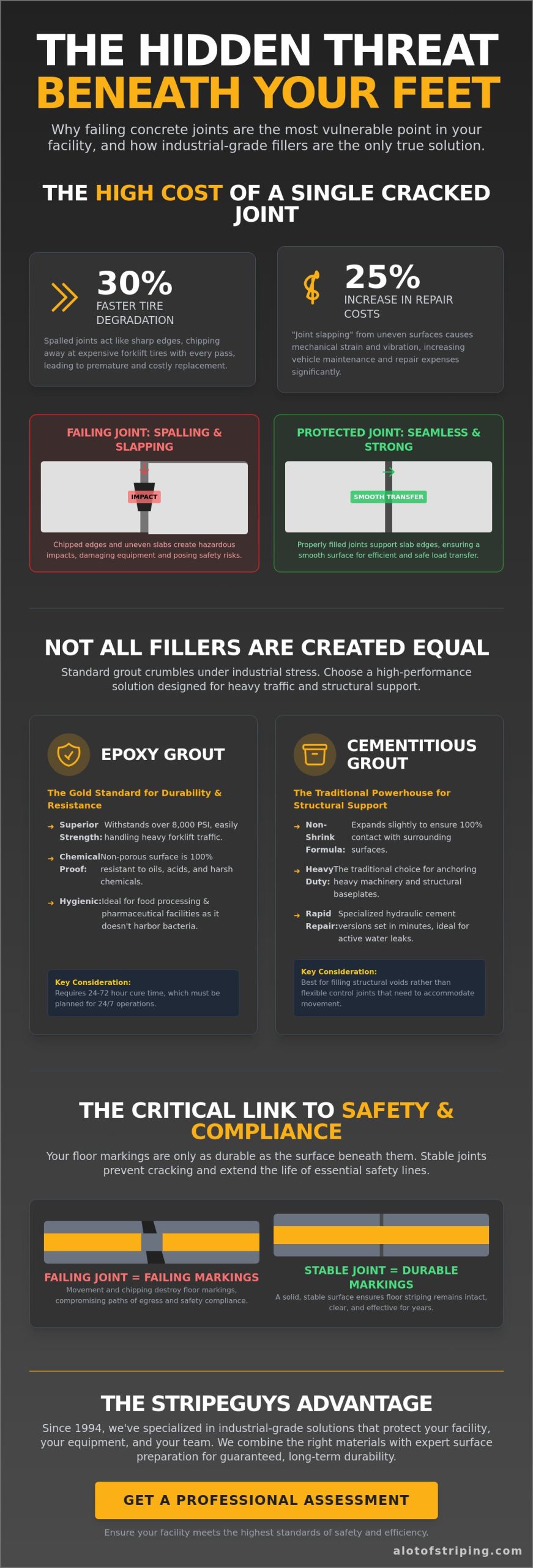
Your facility’s floor joints aren’t just gaps in the concrete; they are the most vulnerable points in your entire operation. A single spalled joint, which is a crack where the edges have chipped away, can degrade forklift tires 30% faster than a smooth surface. This leads to avoidable mechanical strain and safety hazards. Many facility managers mistakenly reach for standard tile grout to patch these areas, but industrial environments require a far more resilient solution. Since 1994, we’ve seen how the wrong material choices lead to crumbling repairs and failing paths of egress within months of application.
You likely already know that a cracked floor is more than an eyesore; it’s a direct threat to your bottom line and your safety record. This guide explains how industrial-grade fillers protect your building’s structural integrity and ensure your floor markings remain durable under heavy traffic. You’ll learn the specific differences between rigid and semi-rigid joint materials, how to reduce facility maintenance costs, and the exact steps to take for a surface that supports both your equipment and your safety standards.
Key Takeaways
- Understand why industrial-grade grout is essential for load transfer and protecting slab edges from heavy forklift traffic.
- Learn to evaluate the compressive strength of cementitious and epoxy materials to ensure your facility’s joints can withstand distribution center demands.
- Discover how proper joint stabilization prevents “bridging” failures and extends the life of your safety floor markings and paths of egress.
- Master a step-by-step inspection protocol to differentiate between cosmetic cracking and structural spalling that threatens operational efficiency.
- Leverage nearly three decades of industrial experience to implement professional surface preparation techniques that guarantee long-term durability for your facility.
Understanding Industrial Grout: More Than Just Tile Filler
Warehouse managers often associate the term grout with the thin lines between bathroom tiles, but in a 100,000-square-foot distribution center, it serves a much more critical structural purpose. This specialized material is designed to fill voids and facilitate load transfer between concrete slabs. If you’re looking for a foundational overview of its composition, you might ask What is Grout? to understand its general properties and how it differs from mortar. We prioritize functional outcomes that keep your facility running at peak efficiency by focusing on the physical realities of the warehouse floor.
Retail-grade products found in local hardware stores lack the compressive strength required to withstand heavy forklift traffic. A standard 5,000-pound forklift carrying a 2,000-pound pallet exerts immense pressure on joint edges every time it passes. Standard materials crumble under this stress, leading to immediate floor failure and safety hazards. StripeGuys has provided durable solutions since 1994, focusing on the safety, quality, and communication triad to ensure your facility remains operational and compliant with modern safety standards. This approach alleviates the logistical stress of facility management by providing a clear timeline and a budget-conscious plan.
Grout vs. Mortar vs. Joint Filler
Material density and flow characteristics define the choice between these substances. We use liquid-state materials for filling baseplates and structural gaps where complete coverage is mandatory. Semi-rigid joint fillers are better suited for saw-cut control joints because they support the slab edge while accommodating natural concrete shrinkage. Industrial grout is a high-strength reinforcement for structural voids.
The Consequences of Ignoring Joint Integrity
Neglecting joint maintenance leads to joint slapping, which occurs when slabs move independently and create an uneven surface. This movement causes concrete spalling (the chipping away of joint edges) and rapidly degrades forklift tires. A 2022 industry report indicates that deferred floor maintenance can increase vehicle repair costs by 25 percent. Beyond the financial impact, uneven joints pose a significant safety risk to operators who face repetitive jarring and potential loss of load control. Addressing these issues immediately ensures your paths of egress remain clear and safe for all personnel.
Types of High-Performance Grout for Industrial Facilities
Choosing the correct grout isn’t just about filling a gap; it’s about structural integrity and operational safety. Since 1994, our team has seen how the wrong material leads to spalled joints and equipment damage. Distribution centers often require materials that handle 8,000 PSI (pounds per square inch) to withstand the constant impact of heavy forklifts. You must match the material to your specific floor profile (the surface texture and flatness) to ensure a permanent bond. The ACI Guide to Concrete Floor and Slab Construction provides the industry baseline for these selections, emphasizing that joint stability is the foundation of floor longevity. If you’re unsure which profile your facility currently has, you can text us for a professional assessment to avoid costly rework.
Epoxy Grout: The Gold Standard for Durability
Epoxy-based materials use a resin and hardener system to create a non-porous, high-strength bond. This chemical composition makes it nearly 100% resistant to oils, acids, and harsh cleaning agents. In food processing or pharmaceutical clean rooms, epoxy is essential because it doesn’t harbor bacteria. While it offers superior durability, it requires a minimum 24-hour window for foot traffic and often 72 hours for heavy equipment. This downtime is a critical logistical factor for 24/7 operations. We often recommend novolac epoxy for environments facing extreme chemical exposure because it provides a higher level of protection against corrosive substances.
Cementitious Grout and Non-Shrink Formulations
Cement-based materials remain the traditional choice for heavy equipment anchoring. Modern non-shrink formulations include expansion agents that counteract the natural contraction of drying concrete. This ensures the material remains in full contact with the baseplate of a machine. Hydraulic cement is a specialized subset used for rapid repairs where water infiltration is a concern. It sets in as little as 3 to 5 minutes. However, cementitious materials are brittle. They lack the flexural strength (the ability to bend without breaking) needed for high-vibration areas or joints subject to significant thermal expansion. For those high-stress zones, we prioritize safety and quality by steering clients toward more resilient resinous options that handle the physical realities of forklift environments.
The Critical Link Between Joint Grout and Floor Striping Longevity
Many facility managers assume that premature line painting failure is a product quality issue. In reality, it is almost always a substrate problem. When epoxy or polyaspartic coatings are applied over an open expansion joint, the material lacks structural support. As 10,000-pound forklifts pass over these gaps, the slab edges deflect. This vertical movement snaps the brittle epoxy, leading to “cracked” lines that peel away from the floor. Proper grout installation creates a flush, monolithic surface. This allows the coating to bond across the entire area without a hollow gap underneath, providing a “bridging” effect that supports the weight of heavy machinery.
In a 2022 overhaul for a regional logistics hub, we demonstrated the financial impact of this preparation. By stabilizing 12,000 linear feet of compromised joints before applying safety markings, the facility realized a 30% reduction in annual re-striping costs. The markings remained intact because the underlying grout eliminated the impact stress that usually chips away at safety lines. Since 1994, our team has seen that the most durable floors are those where the sub-floor preparation is treated with as much importance as the topcoat.
Movement and Adhesion: The Physics of Failure
Concrete is a dynamic material. Thermal expansion and contraction cause slabs to shift significantly during seasonal temperature changes. If a safety line crosses an unfilled joint, that movement creates a fault line that tears the paint. We utilize High-Performance Grouting Materials to stabilize these gaps. This ensures the marking moves with the floor rather than breaking against it. To further secure the bond, we often apply a densifier (a chemical sealer that hardens the concrete surface) to the joint edges. This process strengthens the grout-to-concrete interface and prevents the peeling often seen in high-traffic zones.
OSHA Compliance and Visual Clarity
OSHA 1910.22 requires that all walking-working surfaces are maintained in a clean and safe condition. Open joints act as “dirt magnets” that collect dust and industrial debris, which quickly obscures the edges of your paths of egress (designated safe walking routes). When joints are filled flush with the floor, industrial scrubbers can effectively clean the entire surface. This keeps safety walkways bright and visible for operators and pedestrians alike.
We often hear the question: “Can I just use heavy-duty floor tape instead of repairing the joints?” While tape is a quick fix, it’s rarely a long-term solution in a 24/7 forklift environment. Tape edges eventually lift at the joint, creating trip hazards and snagging on pallet jacks. Relying on our triad of safety, quality, and communication, we recommend permanent filler over temporary adhesives. Repairing the joint is the only way to ensure 100% compliance and protect your budget from constant maintenance cycles.
Assessing and Repairing Failing Concrete Joints in Warehouses
Facility managers should perform a floor walk-through every 30 days to identify deterioration before it compromises equipment. The first step is distinguishing between “spalling” and simple cosmetic grout cracking. Spalling occurs when the edges of the concrete joint chip away under the weight of heavy machinery, creating a widened gap. Cosmetic cracks are often hairline fractures that do not impact structural integrity. If you ignore spalling, the resulting impact points can increase forklift maintenance costs by 20% per year due to premature tire wear and axle damage.
Mechanical removal is the only reliable way to address failing joints. Scraping with hand tools is never enough because it fails to remove deep-seated contaminants or old, brittle resins. StripeGuys utilizes a professional toolkit featuring diamond-tipped saws and specialized dust-free vacuums. We cut the joint clean to its full depth, ensuring 100% of the old material is removed. This mechanical cleaning provides the raw, open-pore surface necessary for a permanent bond.
Surface Preparation: The StripeGuys Method
Adhesion depends on concrete profiling, which involves roughing up the smooth internal walls of the joint. We often use shot blasting to strip away hydraulic fluids and oils that have soaked into the slab over time. Since 1994, our experience shows that 75% of joint failures occur because the installer failed to clean the vertical sidewalls properly. Our team prioritizes safety, quality, and communication by ensuring every inch of the joint is chemically receptive to the new filler before application begins.
Application Techniques for Maximum Strength
We utilize pressure grouting for most industrial applications because it forces the material into the base of the joint, unlike gravity-fed methods that can leave hidden air pockets. Eliminating these voids is critical for supporting the weight of a 10,000-pound forklift. The grout must be installed to a slight overfill and then shaved flush with the floor surface after it reaches the correct Shore A hardness. This flush finish is essential to eliminate the “thumping” sensation that occurs when wheels hit a recessed joint.
After the installation is complete, we perform a series of manual checks to ensure there are no bubbles or “sinkers” where the material has receded. This rigorous post-installation testing ensures the floor remains a smooth path of egress for your crew. If your floor joints are showing signs of wear, you can request a professional site evaluation from our team of experts.
Professional Surface Prep and Grouting: The StripeGuys Advantage
Successful floor maintenance requires more than a bucket of paint and a roller. Since 1994, StripeGuys has specialized in the technical intersection of surface preparation and industrial coatings. We’ve spent nearly three decades refining a process that addresses the root cause of floor failure: the joints. By integrating industrial grout application and joint filler installation into our core striping services, we eliminate the need for managers to coordinate multiple vendors. This single-contractor approach ensures that surface restoration happens before the first line is ever sprayed. It results in a bond that lasts significantly longer than standard applications.
Our specialized approach to warehouse line removal involves more than just grinding away old markings. We focus on surface restoration, which includes repairing the “shadows” or divots left behind by previous contractors. When we identify compromised concrete near paths of egress, we utilize high-strength industrial grout to stabilize spalled edges before applying polyurea fillers. This comprehensive prep work prevents the new striping from chipping or peeling due to underlying structural movement.
- Single-contracting reduces administrative overhead by 25% on average.
- Diamond grinding ensures a CSP (Concrete Surface Profile) of 2 or 3 for maximum adhesion.
- Integrated repairs prevent moisture infiltration that leads to slab curling.
Nationwide Capability for High-Profile Projects
Managing logistics for a 500,000 square foot facility requires a contractor that understands scale. We handle large-scale logistics hub projects across the country without causing operational disruption. Our teams are available 24/7; we work day and night to meet tight facility schedules. We prioritize transparency through direct communication. You’ll receive clear updates on project milestones, ensuring your facility remains compliant with safety regulations without missing a single shipping window.
The Final Result: Safety and Efficiency
Restored joints and fresh, high-visibility striping do more than just look professional. They improve warehouse throughput by allowing forklift operators to maintain consistent speeds without slowing for floor gaps. Professional maintenance reduces long-term facility liability by eliminating trip hazards and clearly defining pedestrian zones. When your floors are level and your lines are crisp, your entire operation runs more safely. Contact StripeGuys today for a professional floor assessment to secure your facility’s future.
Protect Your Floor’s Integrity and Operational Flow
Maintaining a high-volume warehouse requires more than just surface-level cleaning. It demands a technical approach to sub-surface stability. Choosing the correct industrial grout ensures your concrete joints withstand constant forklift traffic without crumbling or causing trip hazards. Since 1994, StripeGuys has seen how failing joints directly impact the lifespan of OSHA-compliant safety markings. When joints fail, the surrounding floor striping peels. This compromises your paths of egress (emergency exit routes) and overall facility safety.
We’ve spent over 29 years refining our specialized diamond grinding and pressure-injected grouting techniques for high-profile nationwide logistics projects. Our team focuses on functional outcomes that keep your facility running within budget. Don’t let deteriorating joints slow down your throughput or lead to expensive floor failures. Professional surface preparation is the only way to guarantee a durable bond between the substrate and your safety systems.
Get a Professional Industrial Floor and Grout Assessment from StripeGuys to ensure your facility remains a safe and efficient environment for your entire team.
Frequently Asked Questions
Is industrial grout different from the grout I buy at a hardware store?
Industrial grout is engineered for high-compressive strength (often exceeding 8,000 PSI) and chemical resistance. Hardware store varieties are typically designed for light foot traffic and aesthetics. Industrial applications require non-shrink properties to ensure the material stays bonded during heavy vibration from 5,000-pound forklifts. Using the wrong material results in immediate cracking under the weight of heavy machinery; it’s a mistake that costs more in the long run.
How long does epoxy grout take to cure before forklifts can drive on it?
Most industrial epoxy grouts require 24 hours for a full cure before supporting heavy forklift traffic. While some fast-set products allow traffic in 4 to 6 hours, rushing the process leads to bond failure. StripeGuys has followed these technical specifications since 1994 to prevent premature joint deterioration. We prioritize functional outcomes to keep your facility running safely without unnecessary downtime or recurring repair costs.
Can I apply warehouse floor striping directly over expansion joints?
You shouldn’t apply warehouse floor striping directly over moving expansion joints. These joints are designed to shift as the building settles or temperature changes. If you paint over them, the coating will crack within 30 days. We recommend stopping the line 1 inch before the joint or using specialized flexible polyurea fillers to bridge the gap properly before applying any durable safety markings to the surface.
What is the best way to remove old, failing grout from a warehouse floor?
Diamond grinding and mechanical sawing are the most effective methods for removing failing grout. We use dust-controlled vertical saws to cut out the old material to a depth of at least 1/2 inch. This process (profiling the joint) creates a clean, porous surface that ensures the new filler bonds permanently to the concrete sidewalls. It’s a technical approach that eliminates the risk of future delamination and floor failure.
Does grout help with load transfer between concrete slabs?
Standard grout doesn’t provide load transfer between slabs; that’s the function of steel dowels or plate systems installed during the pour. However, high-strength industrial grout protects the slab edges (joint nosing) from spalling. When 6,000-pound pallet jacks roll over a filled joint, the material prevents the concrete from chipping under the impact. This protection extends the life of your floor by 40 percent in high-traffic zones.
What happens if I use residential grout in an industrial freezer or cold storage?
Using residential grout in cold storage leads to total failure in less than 90 days. Standard cementitious grouts contain moisture that expands and cracks in sub-zero temperatures. You must use specialized low-temperature polyurea or epoxy that can cure at -20 degrees Fahrenheit. These materials maintain flexibility so they don’t become brittle and shatter under thermal shock. This ensures your freezer floor remains safe and functional for your team.
How often should I inspect the grout and joint fillers in my facility?
Facility managers should perform a formal inspection of all joints and grout every 6 months. High-traffic paths of egress, where forklifts operate 24/7, require monthly spot checks. Catching a 1/4-inch crack early prevents it from becoming a 2-inch spall that damages your equipment’s tires and slows down your production cycle. Our team has helped managers maintain these standards since 1994 to ensure long-term safety and operational efficiency.
Can failing grout cause OSHA safety violations in my warehouse?
Failing grout can lead to OSHA violations under Section 1910.176(a), which requires aisles and passageways to be kept in good repair. If a forklift hits a deep hole caused by missing filler, it can tip or drop a load. OSHA inspectors identify these floor hazards as trip risks for pedestrians and stability risks for heavy machinery operators. Maintaining your floors ensures you stay compliant and avoid costly safety penalties.