
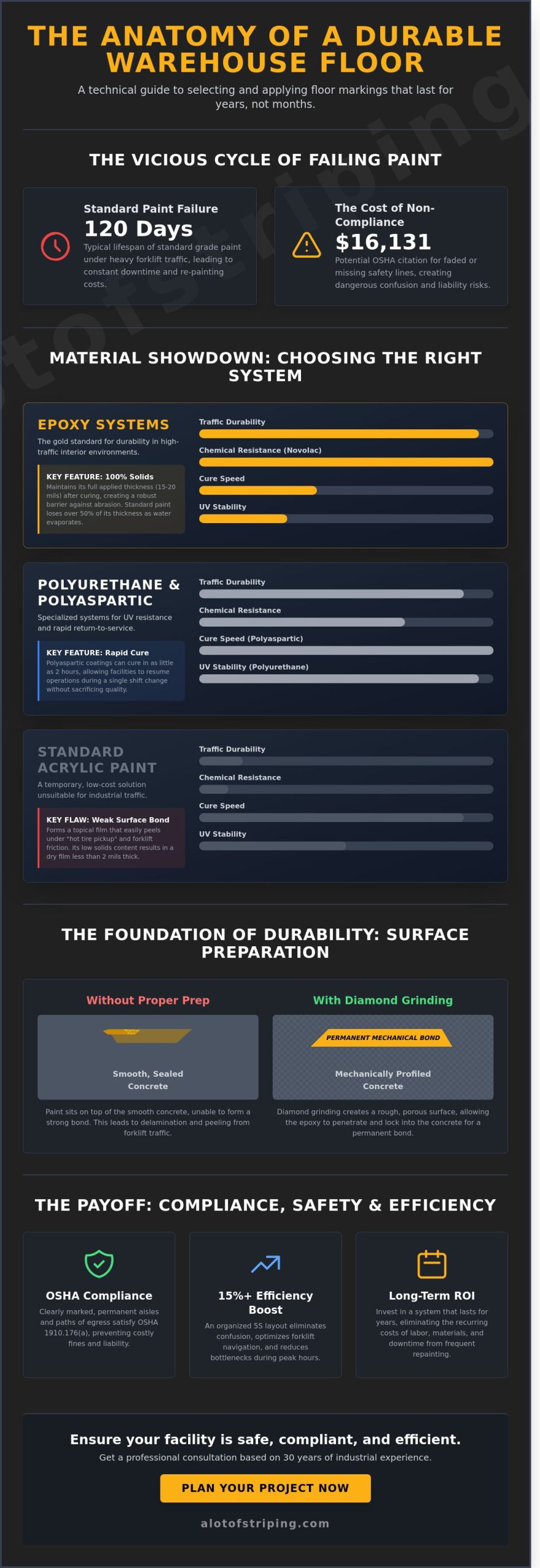
The most expensive warehouse floor marking paint you’ll ever buy is the standard grade coating that fails after just 120 days of heavy forklift use. You already know that peeling lines and faded safety zones don’t just look unprofessional; they invite $16,131 OSHA citations and create dangerous confusion on the floor. It’s a frustrating cycle of operational downtime that wastes your time and drains your facility budget.
Since 1994, StripeGuys has helped managers break this cycle by prioritizing industrial durability over temporary fixes. You’re about to master the technical requirements and specialized application methods needed to ensure your markings survive 24/7 traffic while maintaining a safe, organized environment. We’ll cover everything from diamond grinding (the process of roughing up the smooth concrete surface) to selecting high-performance novolac epoxy for paths of egress. This guide provides the exact blueprint for a compliant facility that stays organized for years, not months.
Key Takeaways
- Identify the technical differences between epoxy, polyurethane, and acrylic systems to select the right resin-based solution for your facility’s specific traffic demands.
- Master the science of concrete profiling (mechanically roughing the surface) to create a permanent bond, eliminating the common causes of coating delamination and failure.
- Implement a standardized 5S layout using high-durability warehouse floor marking paint to optimize pedestrian paths of egress and forklift navigation.
- Leverage professional application standards to achieve precise mil thickness and OSHA compliance, ensuring your facility remains safe, organized, and operational.
Understanding Warehouse Floor Marking Paint and Industrial Safety
Industrial warehouse floor marking paint isn’t a cosmetic upgrade. It’s a specialized safety tool designed for high-traffic environments where split-second decisions happen. StripeGuys has provided these critical markings since 1994, helping facility managers maintain order in 24/7 operations. Clear lines act as the primary navigation system for forklift operators. They reduce the risk of collisions that cause thousands of dollars in product damage and costly logistical bottlenecks. Standard commercial paint fails in these punishing environments because it lacks the chemical bond needed to resist hot tire pickup (the tendency of warm tires to pull paint off the floor). Our approach prioritizes safety, quality, and communication to ensure your facility remains efficient and protected.
The Functional Purpose of Facility Markings
Facility markings create a visual language for your employees. They establish paths of egress (clear exit routes for emergency evacuation) and separate pedestrian traffic from heavy machinery zones. While Floor marking tape is often used for temporary layouts, permanent warehouse floor marking paint provides a durable solution for high-impact areas. Visual cues for staging areas and loading docks prevent clutter from blocking essential workflows. Since 1994, we’ve seen how organized floors can improve warehouse efficiency by 15% or more by eliminating confusion during peak hours.
Regulatory Standards: OSHA and Beyond
OSHA standard 1910.176(a) requires that permanent aisles and passageways be clearly marked. Federal guidelines demand that these markings remain visible and “permanent” to prevent workplace accidents. The cost of ignoring these standards is high. In 2023, OSHA increased maximum penalties for serious violations to $15,625 per occurrence. Beyond fines, poor markings increase liability risks during worker compensation claims. We help managers maintain compliance through technical surface preparation like diamond grinding (roughing up the smooth surface to ensure a mechanical bond). This ensures your color-coded zones meet federal safety guidelines and withstand the daily grind of industrial traffic.
Comparing Industrial Marking Materials: Epoxy, Polyurethane, and Acrylic
Selecting the correct warehouse floor marking paint involves more than picking a high-visibility color. Facility managers must choose between water-borne traffic paints and high-build resinous systems based on the specific mechanical stresses of their environment. The durability of these materials is measured by “mil thickness” (one-thousandth of an inch) and solids content. A standard water-borne paint might apply at 4 mils wet, but once the water evaporates, the remaining dry film thickness (DFT) is often less than 2 mils. In contrast, 100% solids epoxy maintains its full thickness, providing a much more robust barrier against the friction of 10,000-pound forklifts.
Maintaining clear paths of egress is a legal necessity under OSHA 1910.22 General Requirements, which mandates that walking-working surfaces remain in a clean, safe, and accessible condition. Choosing a material that peels or fades within months creates a compliance risk and a logistical headache. Since 1994, we’ve found that matching the resin type to the specific slab activity is the only way to ensure long-term safety and performance.
Epoxy Line Painting: The Gold Standard for Durability
For high-traffic main aisles, 100% solids epoxy is the industry standard. It bonds mechanically to the concrete after diamond grinding (roughing up the smooth surface) to prevent delamination. In specialized environments like chemical processing or battery charging stations, Novolac epoxy provides superior resistance to corrosive spills that would melt standard paint. We often recommend a gloss finish for better light reflectivity, though satin finishes are available to hide micro-scratches in high-friction zones.
Polyurethane and Polyaspartic Coatings
Polyurethane is frequently used as a topcoat because of its excellent UV stability and abrasion resistance. It’s the ideal choice for loading docks where sunlight enters through open bay doors. For facilities that cannot afford 24 hours of downtime, polyaspartic systems are a specialized alternative. These systems can cure in as little as 2 hours, allowing a facility to return to full operational capacity during a single shift change. This speed doesn’t sacrifice quality; it provides a dense, hard-wearing surface that resists tire marking.
Acrylic Traffic Paint: When It Makes Sense
While resinous systems offer longevity, water-borne acrylic traffic paint serves a specific purpose in low-impact areas. If your facility layout changes every 12 months, the ease of re-application makes acrylic a practical choice. It’s a cost-effective solution for:
- Static storage zones with zero forklift traffic
- Temporary staging areas for seasonal inventory
- Pedestrian walkways in low-moisture environments
However, acrylic fails quickly in high-friction turning radiuses where forklift tires pivot. If you need a more permanent solution for high-traffic zones, you can consult with our specialists to determine the best resin for your specific floor profile.
Why Warehouse Paint Fails: The Critical Role of Surface Preparation
Most facility managers assume a clean, smooth concrete floor is the ideal canvas for new lines. This is the primary misconception that leads to coating failure. Smooth concrete is non-porous and acts much like glass; paint cannot grab onto it. For warehouse floor marking paint to endure the daily abuse of 5,000-pound forklifts and heavy pallet jacks, it requires a mechanical bond. This is achieved through concrete profiling, which is the technical process of roughing up the surface to create “teeth” for the paint to grip. Since 1994, StripeGuys has seen that nearly 70% of floor coating failures stem directly from inadequate preparation. When the bond fails, the paint peels and delaminates, resulting in a 100% loss of your safety budget within months.
StripeGuys eliminates this risk by treating surface preparation as a technical discipline rather than a chore. Our commitment to the safety, quality, and communication triad starts with the physical bond between the floor and the finish. We don’t just paint lines; we engineer a safety system that integrates with your facility’s substrate. This professional reliability ensures your markings remain visible and intact for years, not weeks.
Mechanical Removal and Diamond Grinding
We utilize industrial-grade diamond grinding to strip away old, failing lines and stubborn rubber tire marks. This process does more than clean; it opens the “pores” of the concrete. By removing the top layer of laitance, which is the weak, milky layer of cement dust on the surface, we allow the warehouse floor marking paint to penetrate deep into the slab. For food-grade or pharmaceutical facilities, we employ 99.97% efficient HEPA-filtered dustless grinding technology. This keeps your inventory safe from airborne particulates while we prepare the floor. Proper preparation ensures your facility can accurately implement the ANSI Z535.1 Standard for Safety Colors, providing a durable base for high-visibility safety zones that won’t flake under pressure.
Shot Blasting for High-Build Systems
Heavy-duty epoxy and high-build systems require an even more aggressive profile. Shot blasting involves firing thousands of tiny steel metallic abrasives at the floor to blast away deep-seated oils, chemical densifiers, and curing compounds. This method is the industry standard for achieving a Concrete Surface Profile (CSP) level of 3 or 4. We verify the CSP level across the entire application area before a single drop of paint is applied. This no-nonsense approach to technical prep is why StripeGuys is a trusted partner for industrial leaders. We prioritize functional outcomes, ensuring your paths of egress and hazard zones remain permanent fixtures of your operational efficiency.
Designing Your Layout for OSHA Compliance and 5S Efficiency
Effective facility layout design goes beyond simple organization; it creates a predictable environment where safety and productivity coexist. At StripeGuys, we utilize the 5S methodology (Sort, Set in order, Shine, Standardize, Sustain) to transform chaotic floors into high-performance work zones. Since 1994, we’ve helped managers implement these standards to eliminate waste and reduce the risk of industrial accidents. Our approach focuses on the safety, quality, and communication triad, ensuring that every line of warehouse floor marking paint serves a specific operational purpose.
Adhering to OSHA 1910.144 safety color codes is the first step in standardization. We use a precise color palette to communicate hazards instantly:
- Yellow: Designates traffic lanes, aisles, and work cells.
- Red: Identifies fire protection equipment, emergency stops, and “danger” zones.
- Blue: Provides informational signage or instructions for equipment maintenance.
- Green: Marks first aid stations and paths of egress (emergency exit routes).
Aisle and Walkway Architecture
Forklift-pedestrian collisions remain a leading cause of warehouse injuries. To prevent these, we calculate aisle widths based on your specific equipment. OSHA requires aisles to be at least 3 feet wider than the largest piece of equipment, but for two-way forklift traffic, we typically recommend a minimum width of 12 feet. We often install buffer zones (painted “no-man’s lands” between racks and lanes) and physical bollards to protect employees in high-risk areas. For facilities with dim lighting, we mix reflective additives (microscopic glass beads) into the warehouse floor marking paint to ensure paths remain visible at 50 feet or more.
Staging and Storage Optimization
A disorganized dock is a liability. We optimize staging areas by painting “keep clear” zones around fire extinguishers and electrical panels, maintaining the 36-inch clearance required by law. Custom stenciling for SKU locations and dock door numbering reduces searching time, which can increase loading efficiency by 15% in high-volume facilities. We use directional arrows to establish one-way traffic loops, preventing the “gridlock” that occurs when two forklifts meet in a narrow passage. This level of detail ensures your facility remains compliant during surprise inspections while keeping your team moving safely.
Ready to upgrade your facility’s safety and flow? Contact the industrial veterans at StripeGuys for a professional layout consultation and durable floor marking solutions.
Professional Striping Execution: The StripeGuys Advantage
Choosing the right warehouse floor marking paint is only a partial solution for facility safety. The true value lies in the precision of the application and the durability of the chemical bond. StripeGuys brings nearly three decades of industrial striping experience to every project, ensuring that safety lines and paths of egress (the designated exit routes for personnel) remain visible under heavy traffic. We’ve operated since 1994, developing a specialized approach that balances technical expertise with the logistical demands of 24/7 logistics hubs.
Our team operates on a consistent triad: Safety, Quality, and Communication. This framework ensures that every project meets OSHA standards without compromising the speed of your operations. We don’t just apply paint; we act as safety-conscious consultants who understand the high stakes of industrial environments. We prioritize clear boundaries and clean lines, mirroring the efficiency of the facilities we service.
National Reach with Local Expertise
Managing floor marking for a single site is a challenge; coordinating it across 15 or 20 regional branches requires a different level of logistical mastery. We provide national coverage for large-scale distribution centers, maintaining consistent quality standards across the United States. This uniformity is vital for high-profile industrial clients who need their safety protocols to look and function the same in every warehouse they operate. We handle the complex logistics of multi-site projects so facility managers can avoid the headache of managing multiple local contractors.
For those seeking similar professional standards for residential projects, Higher Impact Painting provides specialized interior and exterior painting services for homeowners and residential property managers.
Partnering with an Industrial Veteran
Experience since 1994 means we’ve seen every type of concrete failure and surface contamination imaginable. This history allows us to select the optimal warehouse floor marking paint for your specific slab conditions while providing transparent pricing and detailed project timelines. We understand that downtime costs money. That’s why we offer day and night availability to eliminate operational interruptions. Whether your facility requires diamond grinding (roughing up the smooth surface for better adhesion) or specialized novolac epoxy, we deliver results that withstand the physical realities of heavy forklift environments.
Our commitment to transparency means you’ll always know the status of your project. It’s time to work with a partner who values your schedule as much as your safety. We’re ready to help you organize your facility for maximum efficiency and long-term durability.
Optimize Your Operational Safety and Efficiency
Effective facility management relies on the physical integrity of your floor markings. Selecting the right warehouse floor marking paint is only the first step. The real value lies in professional surface preparation through diamond grinding, which involves roughing up the smooth concrete to ensure long term adhesion. High performance epoxy and polyurethane systems provide the chemical resistance needed for heavy forklift traffic and 24 hour operations. Since 1994, StripeGuys has specialized in these high stakes industrial environments. We understand that your facility can’t stop for maintenance; that’s why we offer 24/7 execution to ensure zero downtime for your team. With over 29 years of industrial experience, we focus on the safety, quality, and communication triad to deliver paths of egress that meet every OSHA standard. It’s time to move beyond temporary solutions and invest in permanent industrial durability. Our team is ready to help you organize your space and protect your workers today.
Get a professional quote for your warehouse striping project today
We look forward to making your facility a safer and more productive environment.
Frequently Asked Questions
How long does warehouse floor marking paint take to dry and cure?
Standard acrylic warehouse floor marking paint typically dries to the touch within 60 minutes, but full chemical curing for heavy forklift traffic requires a 24 to 72 hour window. High-solids epoxy systems often need a minimum of 12 hours before foot traffic is permitted and 48 hours before 5,000 pound forklifts can operate safely. We prioritize your operational uptime by scheduling applications during low-activity shifts to ensure the substrate reaches maximum durability.
Is floor paint or floor tape better for high-traffic warehouses?
Industrial paint outperforms floor tape in 90% of high-traffic zones because it bonds directly to the concrete pores. Tape often peels or flags when 10,000 pound reach trucks execute tight turns, creating trip hazards that violate safety protocols. While tape offers a quick temporary fix, a professional application of warehouse floor marking paint provides a flush surface that resists the shearing forces of constant pallet movement and heavy equipment use.
What are the OSHA color requirements for warehouse floor markings?
OSHA standard 1910.144 dictates specific colors for facility safety, including yellow for caution and marking physical hazards like trip points or aisle boundaries. Red identifies fire protection equipment and emergency stop buttons, while green marks first aid kits and paths of egress (emergency exit routes). We follow the 1910.22 walking-working surfaces mandate to ensure all 2 inch or 4 inch lines provide clear, visible boundaries for your workforce and visiting inspectors.
How do you remove old warehouse floor lines without damaging the concrete?
Diamond grinding is the most effective method for removing legacy lines because it mechanically shaves the top 1/16th inch of the concrete surface without causing structural micro-fractures. This process removes old resins and creates a CSP 2 or 3 profile (concrete surface profile), which is essential for the new coating to adhere properly. Avoiding chemical strippers prevents the introduction of hazardous fumes into your ventilation system and ensures a cleaner bond for replacement markings.
Can you paint over concrete sealers or densifiers?
You can’t paint directly over concrete densifiers or silane-based sealers because these treatments are designed to repel liquids and will cause the paint to delaminate within 30 days. We use planetary grinders to remove the sealed layer and open the concrete capillaries, ensuring the new material anchors deep into the slab. Skipping this mechanical preparation step (roughing up the smooth surface) results in a 75% higher failure rate for floor markings in industrial environments.
How often should warehouse floor markings be refreshed?
High-traffic facilities typically require a refresh every 12 to 24 months to maintain compliance with safety visibility standards. In low-impact storage areas, a quality epoxy coating can last 5 years or longer before showing significant wear. We recommend an annual safety audit of your lines to identify faded sections that could lead to forklift accidents or OSHA citations during a random inspection. Regular touch-ups prevent small wear patterns from becoming major safety liabilities.
What is the best way to clean and maintain epoxy floor lines?
Use a neutral pH cleaner and an automatic floor scrubber equipped with soft-bristle brushes to maintain the visibility of your epoxy lines. Harsh acidic cleaners or stiff wire brushes will scratch the surface and dull the pigment, making the markings harder to see in low-light conditions. Regular maintenance prevents the buildup of tire rubber and carbon dust, which can obscure safety boundaries and decrease the coefficient of friction on the floor for your walking staff.
Does StripeGuys provide national service for multi-state facilities?
StripeGuys provides national service for multi-state industrial portfolios, ensuring consistent safety standards across every location you manage. Since 1994, we’ve focused on delivering professional reliability through a single point of contact for facilities from coast to coast. Our team coordinates logistics and night-shift scheduling to minimize downtime, applying nearly three decades of expertise to every project regardless of the geographic location. We prioritize clear communication and adherence to your specific facility budgets.