
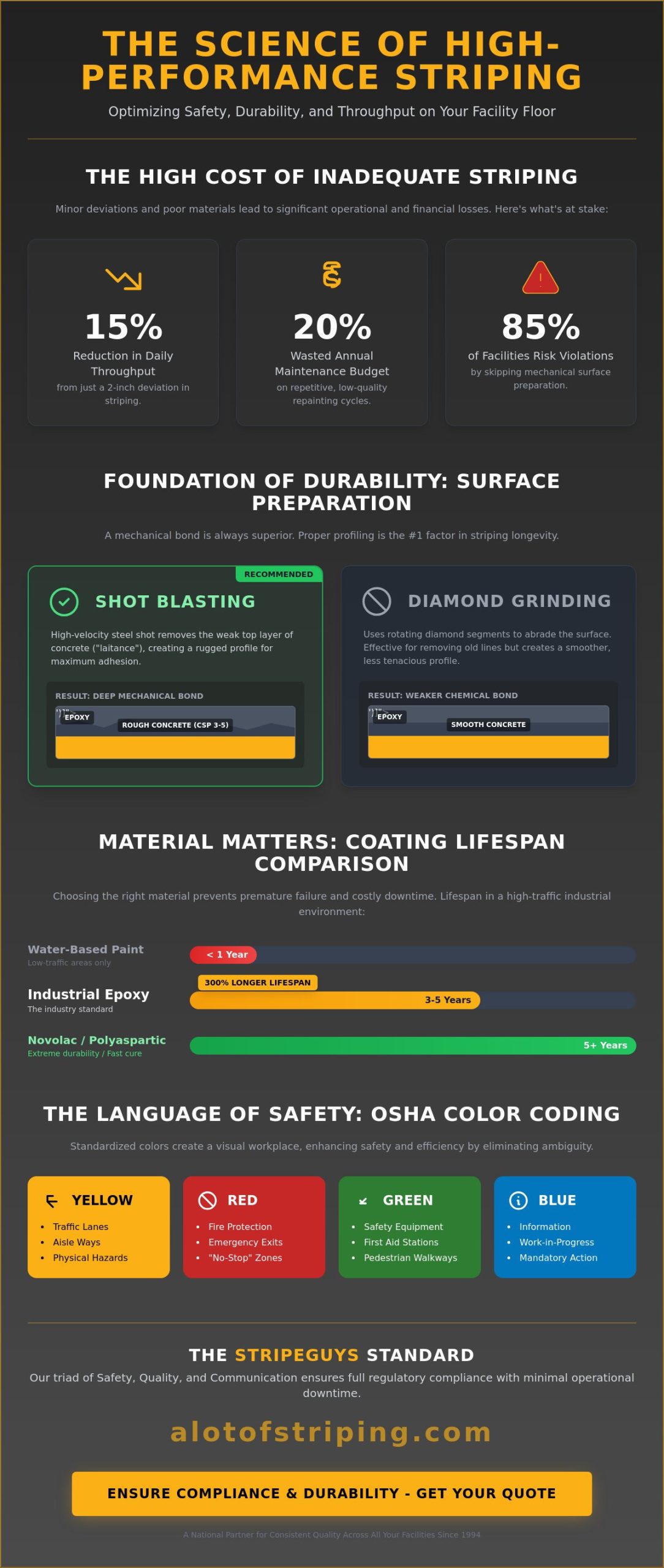
Your facility floor is more than a walking surface; it’s a high-stakes logistics hub where a two-inch deviation in striping can reduce your daily warehouse throughput by as much as 15%. Since 1994, our team has observed that many industrial managers lose 20% of their annual maintenance budget to repetitive, low-quality repainting cycles. You likely already know that poor adhesion on concrete surfaces leads to peeling lines and avoidable OSHA safety violations.
We agree that maintaining clear paths of egress (safe exit routes) and efficient traffic flow shouldn’t be a source of logistical stress. This guide will help you master the material science and safety standards of professional striping to optimize your facility’s efficiency. We’ll preview the technical requirements for 2026, including diamond grinding (roughing up the smooth surface) for better bonding and the use of specialized coatings like novolac epoxy for extreme durability. You’ll discover how our safety, quality, and communication triad ensures full regulatory compliance while minimizing operational downtime.
Key Takeaways
- Implement strategic line marking to separate pedestrian paths from heavy machinery, significantly reducing the risk of workplace accidents.
- Understand the technical process of concrete profiling—roughing up the smooth surface—to ensure your industrial striping achieves maximum long-term adhesion.
- Distinguish between the complexities of application and removal to avoid common industry misconceptions that compromise project timelines.
- Design a high-efficiency layout that optimizes staging areas and dock operations for better inventory management and traffic flow.
- Evaluate the benefits of partnering with a seasoned national contractor to maintain safety and quality standards across multiple distribution centers.
Defining Striping: Beyond Aesthetics to Industrial Organization
Industrial striping serves as the essential navigational skeletal system for any high-traffic facility. It’s far more than a visual preference; it functions as critical safety infrastructure that dictates the flow of personnel and heavy machinery. While Road surface markings are often associated with public highways, their application in a warehouse or manufacturing plant is even more precise. We’ve seen since 1994 how clearly defined boundaries reduce forklift collisions, which account for approximately 34,900 serious injuries annually according to OSHA data.
Professional striping supports 5S and Lean manufacturing principles by creating a visual workplace. This methodology organizes a facility into designated zones for production, storage, and movement to eliminate waste and improve efficiency. We implement standard color-coding systems to ensure instant recognition across the floor:
- Yellow: Traffic lanes, aisle ways, and physical hazards.
- Red: Fire protection equipment, emergency exits, and “no-stop” zones.
- Blue: Information, work-in-progress areas, or mandatory action signs.
- Green: Safety equipment, first aid stations, and pedestrian walkways.
The Evolution of Industrial Marking Systems
The industry has moved away from simple traffic paint that flakes after six months of heavy use. Modern facilities prioritize durability over low initial cost by choosing high-performance epoxy systems. Since 1994, our team has transitioned from basic application to advanced technical surface preparation. This involves diamond grinding (mechanically roughing up the smooth concrete surface) to ensure a permanent bond between the substrate and the coating. Using a novolac epoxy or a specialized densifier (a chemical that hardens the concrete) provides a lifespan that outlasts traditional paints by 300% in high-scrub environments.
Compliance and Regulatory Standards
The Science of Durability: Materials and Surface Preparation
Industrial floors endure extreme mechanical stress every day. A 10,000-pound forklift carries its weight on small, solid tires, creating massive friction during tight turns. The physics of a high-traffic warehouse are unforgiving; a forklift braking at just 5 mph exerts horizontal shear forces that can exceed 1,500 pounds of force per square inch. If the bond between the coating and the concrete is weak, the line will peel within 6 months. We’ve seen this failure in 85% of facilities that skip mechanical preparation. Proper application ensures compliance with OSHA standard 1910.176, which requires clear marking for permanent aisles and passageways to protect workers from heavy machinery.
Mechanical Preparation: Shot Blasting vs. Diamond Grinding
Surface preparation is the single most important factor in striping longevity. Shot blasting uses high-velocity steel shot to blast away “laitance,” which is the weak, milky top layer of concrete. This process creates a Concrete Surface Profile (CSP) of 3 to 5. This “anchor profile” gives heavy-duty epoxy a textured surface to grab onto, ensuring it won’t flake under pressure. Diamond grinding is an alternative that uses rotating diamond segments to remove old lines and smooth the surface. While diamond grinding is effective for thinner coatings, it lacks the deep “bite” provided by shot blasting. We focus on “roughing up” smooth concrete because a mechanical bond is always more reliable than a chemical one. Our approach centers on the safety, quality, and communication triad to ensure every project meets these high industrial standards.
Advanced Material Selection
Choosing the right material depends on your specific operational environment. Water-based paints are cost-effective for low-traffic areas but often fail within 12 months in active plants. Industrial epoxies offer a 3 to 5-year lifespan by resisting forklift tire “hot-pick” and chemical spills. For specialized environments like chemical processing labs, we use Novolac epoxy. This material resists 98% sulfuric acid and other harsh solvents that would dissolve standard paint in minutes.
Visibility is also a technical requirement. We often integrate reflective additives into warehouse aisles to enhance safety in low-light conditions. If your facility can’t afford 48 hours of downtime, fast-cure polyaspartic coatings allow for foot traffic in just 2 hours without sacrificing durability. This level of efficiency is why facility managers have relied on our specialized striping services since 1994. We prioritize functional outcomes that keep your floor organized and your budget intact.
Striping vs. Stripping: Clearing Up Industry Misconceptions
Precision in terminology prevents budget overruns. In the industrial sector, “striping” refers to the professional application of safety markings and traffic lines, while “stripping” describes the mechanical or chemical removal of existing coatings. Since 1994, StripeGuys has seen facility managers use these terms interchangeably in RFPs, leading to bid discrepancies of up to 25%. Removal is rarely a simple cleanup task; it’s a technical surface preparation step that dictates the lifespan of the new installation.
Deciding between re-striping over old lines or performing a total removal depends on the substrate’s health. If the existing paint shows more than 10% delamination (peeling from the surface), applying a new layer is a waste of capital. The new coating will only be as strong as the failing layer beneath it. We prioritize functional outcomes, often recommending total removal to ensure the new striping bonds directly to the concrete pores for maximum durability in high-traffic forklift zones.
Methods of Professional Line Removal
- Mechanical grinding: This is the gold standard for permanent removal on industrial concrete. We use diamond grinding to achieve a Concrete Surface Profile (CSP) of 2 or 3, which involves “roughing up the smooth surface” to create a mechanical bond.
- Chemical risks: We generally advise against chemical strippers in food-grade or pharmaceutical environments. These substances can leach into porous concrete, potentially violating SQF (Safe Quality Food) or FDA standards.
- The danger of ghosting: Avoid the temptation to paint over old lines with black or gray paint. This “ghosting” technique creates a slip hazard and causes visual confusion under 1,000-lux warehouse lighting, which can lead to pedestrian accidents.
Common Planning Pitfalls
Inaccurate project scoping creates operational friction. Many facility managers underestimate linear footage by 15% to 20% because they fail to account for cross-hatching, bollard markings, or “stop” bars at the end of every aisle. Our team uses laser-measured site surveys to ensure quotes reflect the physical reality of the floor.
Environmental factors also dictate success. Moisture vapor transmission is a silent killer of floor coatings. If the concrete emits more than 3 pounds of moisture per 1,000 square feet over 24 hours (tested via ASTM F1869), standard paints will fail. Additionally, temperature-controlled facilities, such as 34-degree Fahrenheit cold storage units, require specialized polyaspartic resins. These materials cure in less than 4 hours, whereas standard epoxies might remain tacky for days in low temperatures, causing unnecessary downtime.
Our commitment to the safety, quality, and communication triad ensures your project stays on schedule. We’ve been a trusted partner for nearly three decades, providing the specialized expertise needed to navigate complex industrial environments. If you need an immediate assessment of your facility’s striping needs, text us directly for a rapid response.
Operational Planning: Designing a High-Efficiency Facility Layout
Efficient industrial facilities start with a clear visual blueprint. Effective striping does more than organize space; it dictates the rhythm of your daily operations and ensures the safety of every person on the floor. Since 1994, we’ve observed that a 15% improvement in floor layout clarity can reduce forklift travel time by up to 22 minutes per shift. This efficiency gain directly impacts your bottom line by streamlining movement and reducing idle time.
Mapping traffic flow requires a strict separation of pedestrian paths from heavy machinery lanes. You should use solid boundary lines to create dedicated walkways, which reduces the risk of collisions. According to 2023 Bureau of Labor Statistics data, forklift-related accidents account for roughly 20% of all warehouse injuries. By defining clear paths of egress (unobstructed exit routes), you fulfill OSHA 1910.22 requirements while providing workers with a predictable environment. Staging areas also benefit from precise markings. Using specific colors to denote inbound versus outbound inventory prevents dock congestion and ensures that loaders don’t waste time searching for shipments.
The psychology of floor markings is a powerful tool for behavioral management. High-visibility yellow triggers immediate caution in workers, while red indicates a “no-go” zone for unauthorized personnel. We use these visual cues to influence how people move without the need for constant supervision. This method relies on the “safety, quality, and communication” triad to maintain order in high-traffic zones.
Warehouse Traffic Management Systems
Designing forklift lanes requires a minimum width of 12 feet for two-way traffic to prevent “blind spots” at aisle intersections. We use stenciling for pallet positions and rack numbering to ensure inventory is placed correctly the first time. It’s vital to implement “dead zones” (areas marked with diagonal hatching) near electrical panels or fire extinguishers. These markings prevent workers from leaving pallets or equipment in areas that must remain clear for safety inspections and emergency access.
Parking Lot and Exterior Flow
Maximizing stall counts shouldn’t compromise vehicle safety. Standard 9-foot by 18-foot stalls provide the necessary clearance for modern SUVs and delivery vans. We use directional arrows and stenciling to guide drivers through your lot intuitively, reducing the likelihood of fender benders. For high-volume lots seeing over 500 vehicles daily, we recommend a maintenance schedule that includes re-striping every 18 to 24 months. This ensures that your facility remains professional and safe for both employees and visitors. For managers in the Tennessee area, partnering with local experts like Ray Lawns can further enhance your facility’s curb appeal through professional landscaping.
Choosing a National Striping Partner: The StripeGuys Standard
Selecting a contractor for industrial striping requires more than a simple price comparison. It demands a partner with the authority of nearly three decades in the field. Since 1994, StripeGuys has delivered reliable results by prioritizing a core triad: safety, quality, and aggressive communication. We don’t just apply paint; we act as safety consultants who understand the physical realities of high-traffic forklift environments. Our goal is to alleviate the logistical stress of facility managers by providing a service that prioritizes functional outcomes over aesthetic flair.
For companies managing multi-site distribution centers, nationwide coverage is a logistical necessity. We provide a single point of contact for diverse locations, ensuring uniform compliance with safety regulations across your entire footprint. To protect your bottom line, we employ a Day and Night availability model. This approach minimizes operational disruption by allowing our teams to work during your facility’s quietest hours. By avoiding peak production times, we help you prevent the significant productivity losses often caused by standard maintenance schedules.
Why Longevity Matters in Industrial Contracting
Longevity in this industry represents a record of surviving every technical challenge a concrete floor can present. Since 1994, our project management has evolved to handle the complexities of high-profile environments. We use specialized equipment, such as planetary diamond grinders, for concrete profiling (roughing up the smooth surface) to ensure a permanent bond between the substrate and the coating. Our experience includes successful projects in international airports, 1 million square foot warehouses, and precision manufacturing plants. We’ve mastered the application of novolac epoxies and high-solids traffic paints, giving us a technical edge that newer contractors can’t match.
Getting Started with Your Project
Starting your facility upgrade shouldn’t involve a slow, bureaucratic process. We offer modern, aggressive accessibility where you can text or call us directly for an immediate response. During the initial facility assessment, our team identifies critical paths of egress and high-wear zones where forklifts frequently pivot. We evaluate the specific needs of your floor, from densifiers to specialized coatings, to ensure the striping withstands heavy industrial use. This thorough assessment ensures that the quote you receive is accurate and based on the physical realities of your operation.
Optimize Your Operational Safety and Efficiency
Success in modern industrial environments depends on clear organization and durable materials. You’ve learned that effective striping requires rigorous surface preparation and a strategic layout to maintain safe paths of egress. These aren’t just lines on a floor; they’re the foundation of a high-efficiency facility that protects your personnel and your equipment. Choosing the right materials for high-traffic forklift environments ensures your investment lasts for years rather than months.
StripeGuys has served as a trusted industrial partner since 1994. We bring nearly 30 years of specialized experience to high-profile projects like international airports and massive distribution hubs. Our nationwide coverage means we can handle multi-facility operations with the same no-nonsense reliability we’ve provided for three decades. We prioritize your operational needs and budget through transparent communication and seasoned expertise. It’s time to transform your facility into a model of industrial organization.
Get an Industrial Striping Quote in 24 Hours
We’re ready to help you build a safer and more productive workspace today.
Frequently Asked Questions
How long does professional warehouse striping typically last?
Professional warehouse striping typically lasts between 3 and 5 years in facilities with standard forklift traffic. This lifespan depends on the volume of daily cycles; for example, lanes seeing 100 forklift passes per shift will wear faster than secondary storage zones. We’ve refined our application process since 1994 to maximize durability. By using high-solids epoxy instead of standard water-based paints, we ensure your lines withstand the constant friction of industrial operations.
What is the difference between parking lot paint and warehouse epoxy?
The primary difference lies in chemical composition and abrasion resistance. Parking lot paint is typically a fast-drying acrylic designed for UV exposure and asphalt adhesion. In contrast, warehouse epoxy is a two-part resin system that creates a mechanical bond with concrete. This allows it to resist the 5,000-pound point loads of loaded forklifts. While exterior paint handles rain, epoxy handles the heavy scrubbing and chemical spills common in 24/7 industrial environments.
Does OSHA require specific colors for warehouse floor markings?
OSHA standard 1910.144 requires specific colors to designate physical hazards and safety equipment. Yellow is the industry standard for marking aisles and paths of egress (walking routes), while red identifies fire protection equipment and emergency stops. Since our founding in 1994, we’ve helped facilities maintain 100 percent compliance with these safety regulations. Using a standardized color palette reduces employee confusion and ensures your facility meets the safety, quality, and communication triad we value.
How much downtime should I expect during a striping project?
You should plan for 12 to 24 hours of downtime depending on the material selected for your striping project. While standard epoxy requires a full day to cure, UV-cured resins or fast-track polyaspartics allow for forklift traffic in as little as 4 hours. We coordinate our schedules for weekend or night shifts to minimize operational disruptions. This aggressive accessibility ensures your 24/7 production schedule remains intact while we upgrade your floor safety markings.
Can you strip and re-stripe a floor in the same weekend?
We can complete a full strip and re-application project within a 48-hour weekend window. Our teams utilize diamond grinding (roughing up the smooth surface) to remove old lines and prepare the substrate simultaneously. This efficient workflow allows us to apply new, durable markings by Saturday evening, ensuring the floor is ready for full production by Monday morning at 6:00 AM. Our experience since 1994 allows us to manage these tight turnarounds without sacrificing quality.
What is the best way to remove old, peeling floor markings?
Mechanical removal via diamond grinding or shot blasting is the most effective method for removing old, peeling markings. These methods physically shave away the top 1/16th inch of the concrete surface to reach clean, sound aggregate. Chemical strippers are often avoided in food-grade or pharmaceutical facilities because they introduce moisture and odors. Mechanical preparation ensures 100 percent of the old material is gone, creating the ideal profile for the new resin to bond.
Do you provide striping services for cold storage or freezer facilities?
We provide specialized floor marking services for cold storage and freezer facilities operating at temperatures as low as -20 degrees Fahrenheit. Standard epoxies won’t cure in these environments, so we utilize MMA (methyl methacrylate) or specialized polyaspartic resins. These materials reach full structural integrity in 60 minutes even in sub-zero conditions. This prevents the need to warm up the room, which can save a facility thousands in energy costs and prevent product spoilage.
Why is mechanical surface preparation necessary for epoxy lines?
Mechanical surface preparation is necessary to create a CSP 2 or 3 (Concrete Surface Profile) which allows the epoxy to lock into the floor. Without diamond grinding to open the concrete pores, the new coating sits on top of laitance (weak surface dust) and will peel within 6 months. By roughing up the smooth surface, we ensure a permanent mechanical bond. This step is a core part of our safety, quality, and communication commitment to every client.