
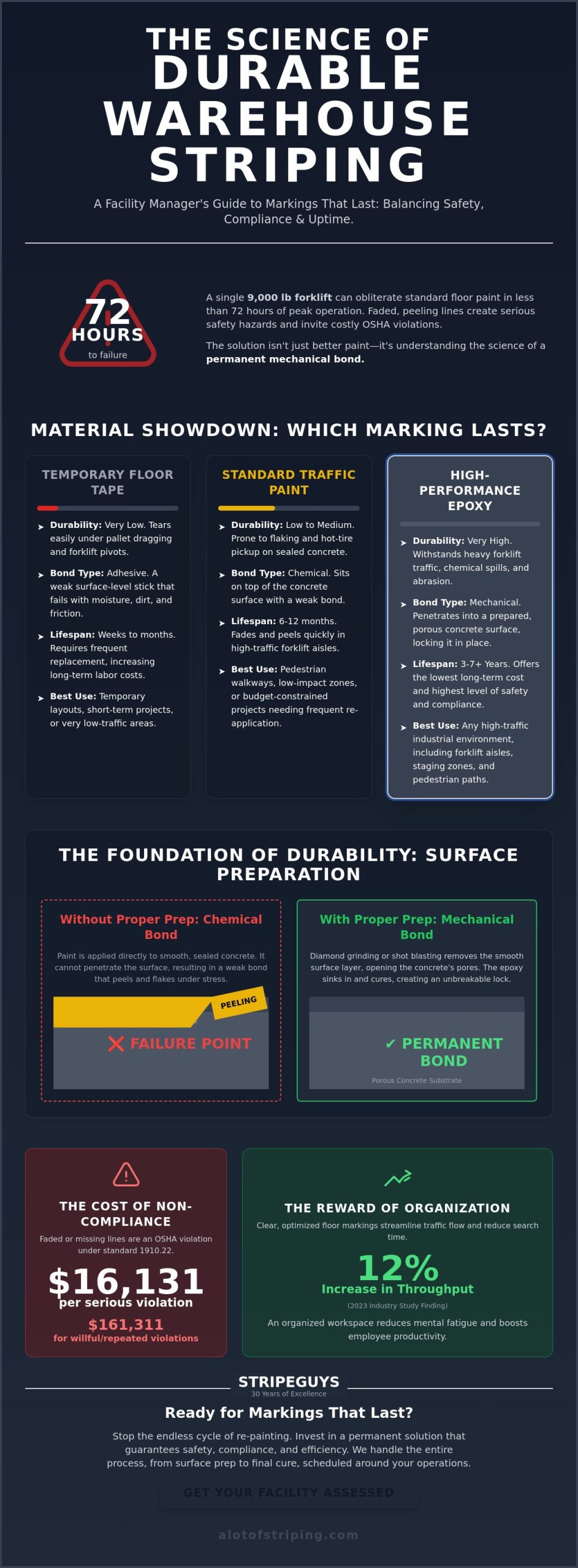
A single 9,000 pound forklift dragging a pallet can destroy standard floor paint in less than 72 hours of peak operation. For facility managers, warehouse striping is often a source of recurring frustration because lines fade or peel, leading to safety hazards and potential OSHA fines that can exceed $16,131 per serious violation. You already know that keeping your floor markings visible is essential for both safety and throughput, yet finding a window for installation that doesn’t halt your 24/7 production feels nearly impossible.
StripeGuys has specialized in these high-stakes environments since 1994, and we understand that you need more than just paint on concrete. This guide shows you how to master the material science and technical requirements behind durable markings. We’ll cover everything from diamond grinding (roughing up the smooth surface for better adhesion) to selecting the right novolac epoxy for chemical resistance. You’ll learn our proven framework for achieving full safety compliance and long-lasting visibility without sacrificing your operational schedule or budget.
Key Takeaways
- Learn how a systematic organizational strategy balances OSHA compliance with operational throughput to protect your workforce and streamline traffic.
- Understand the science of mechanical bonding and why high-performance industrial epoxy outperforms budget traffic paint in high-traffic forklift environments.
- Discover why temporary solutions like floor tape often fail and how to transition to permanent markings that meet strict safety requirements.
- Master the technical requirements of warehouse striping to optimize your facility layout and maximize linear footage efficiency.
- Gain insights into professional project planning, from diamond grinding surface preparation to scheduling weekend shutdowns that eliminate operational downtime.
What is Warehouse Striping and Why is it Critical for Safety?
Warehouse striping is the systematic application of safety lines, directional cues, and organizational markings on an industrial floor. It’s a foundational infrastructure requirement that dictates how people and machines move through a space. Since 1994, StripeGuys has treated these markings as more than just paint; they’re a vital communication tool. This system serves a dual role by enhancing operational efficiency and ensuring employee safety in high-traffic environments. Without clear boundaries, a facility quickly descends into a chaotic and hazardous workspace.
The financial stakes of ignoring these markings are high. Non-compliance leads to steep penalties. In 2024, OSHA increased the maximum penalty for serious and other-than-serious violations to $16,131 per violation. For willful or repeated violations, that figure jumps to $161,311. Beyond fines, poorly marked floors lead to workplace accidents that increase insurance premiums and cause costly downtime. Professional warehouse striping targets three core areas: forklift aisles, pedestrian walkways, and staging zones (the designated spots for incoming or outgoing freight).
While temporary solutions like Floor Marking Tape are often used for testing new layouts, permanent industrial coatings are the standard for durability in 2026. These markings must withstand the constant friction of 10,000-pound forklifts and pallet jacks. Our approach focuses on the safety, quality, and communication triad to ensure your facility meets these rigorous demands while staying on budget.
The Impact on Operational Efficiency
Clear floor boundaries directly reduce “search time” for pallet positions and specific inventory. When every zone is clearly defined, workers don’t waste seconds or minutes guessing where a shipment belongs. This organization streamlines traffic flow to prevent forklift bottlenecks in high-volume hubs, especially during peak shifts. A 2023 industry study indicated that facilities with optimized floor markings saw a 12% increase in throughput. There’s also a psychological benefit; a clean, organized workspace improves employee productivity by reducing the mental fatigue associated with navigating a cluttered environment.
Safety Standards and Paths of Egress
Defining “paths of egress” (clear, unobstructed exit routes) is a non-negotiable safety requirement for any industrial facility. These routes must remain visible even during power failures or emergency evacuations. We follow industry-standard color-coding to ensure instant recognition: Yellow indicates traffic lanes and aisles, Red identifies fire-related hazards or emergency stops, and Green marks the location of safety equipment like eyewash stations. OSHA 1910.22(c) requires that permanent aisles and passageways be appropriately marked to ensure the safe movement of mechanical handling equipment and personnel. By adhering to these standards, facility managers protect their workforce and their bottom line simultaneously.
The Science of Durability: Materials and Surface Preparation
Most facility managers experience the frustration of lines that peel or fade within six months of application. This failure occurs because “paint on top” methods rely on a weak chemical bond to the surface layer of concrete. For warehouse striping to survive 24/7 forklift traffic and heavy pallet dragging, it requires a mechanical bond. This means the coating must physically lock into the open pores of the concrete substrate. StripeGuys has refined this process since 1994, focusing on functional longevity over quick, aesthetic fixes. While budget-friendly traffic paint works for low-impact zones, high-performance industrial epoxy systems are the standard for 90% of our heavy-duty projects.
Modern industrial floors often utilize densifiers and sealers to harden the slab and reduce dusting. These chemicals make the concrete surface non-porous and extremely smooth. Without the right preparation, even the most expensive industrial coatings will flake off these treated floors like a sticker. Compliance isn’t just about the color of the line; it’s about permanence and visibility. Under OSHA 1910.22, aisles and passageways must be kept clear and appropriately marked to ensure worker safety. If your lines are peeling or obliterated by tire marks, you aren’t just failing an internal audit; you’re violating a federal safety standard that mandates clear marking of permanent aisles.
Mechanical Preparation: Shot Blasting and Diamond Grinding
Concrete profiling is the process of roughing up the smooth surface to create “teeth” for the coating to grab. We choose the method based on your floor’s current condition. Shot blasting uses high-velocity steel beads to strip away the top layer of cream. It’s the most aggressive choice for floors with heavy oil contamination or thick, failing old coatings. Diamond grinding uses industrial-grade abrasive discs to create a smoother profile. This is ideal for thinner coatings or when a precise, clean edge is required. For food-grade or pharmaceutical environments, we utilize dustless removal systems. These HEPA-filtered vacuums capture 99.9% of concrete dust at the source, keeping your sensitive inventory safe during the installation process.
Epoxy vs. Polyurethane vs. Polyaspartic
Material selection is the core of our “No-Nonsense” approach. We don’t believe in a one-size-fits-all solution for every facility. Material choice depends on your traffic volume and environmental exposure.
- Epoxy: The industry standard for high-build, durable safety lines. It offers excellent adhesion and impact resistance for standard 2026 warehouse operations.
- Polyurethane: We recommend this for specialized plants needing superior UV resistance or protection against harsh chemical cleaners.
- Polyaspartic: This is a rapid-cure technology. It’s the go-to for high-volume facilities that can’t afford a 24-hour shutdown, as it’s often ready for traffic in just a few hours.
We match the chemistry to your specific forklift count and floor history. If you’re unsure which system fits your operational needs, you can request a floor evaluation from our experienced team to find the most cost-effective path forward.
Navigating OSHA Compliance for Floor Markings
OSHA standards for warehouse striping aren’t just suggestions; they’re enforceable regulations designed to prevent the 95,000 forklift accidents reported annually in the United States. You must distinguish between “guidelines” and “requirements” to avoid heavy fines during an inspection. OSHA 1910.22(d)(1) mandates that all permanent aisles and passageways must be clearly marked. While some facilities use adhesive tape to save on initial costs, it’s often a liability. Tape typically peels within 6 months in high-traffic zones, creating trip hazards and obscuring boundaries that lead to safety violations. Professional paint applications provide the industrial durability needed for heavy machinery environments.
Clearance is a critical metric for safety inspectors. Aisle widths must be at least 3 feet wider than the largest piece of equipment used in that space to ensure safe passage for both vehicles and workers. This spacing is vital for Warehouse and Loading Dock Safety, where congestion frequently leads to collisions. Additionally, stenciling is required for specific hazards. Fire extinguishers and electrical panels require a 36-inch clearance zone, often marked with red and white diagonal lines to prevent employees from blocking access. Hazardous material storage areas must also feature clear, legible stenciling to meet federal Right-to-Know standards.
Standardized Color Coding for Industrial Facilities
Forklift Safety and Pedestrian Separation
Separating human traffic from heavy machinery is the most effective way to prevent workplace fatalities. Implement “no-go zones” using solid boundaries to keep pedestrians away from active forklift paths. Use “zebra striping” (diagonal alternating stripes) at intersections to alert drivers to high-risk crossing points. For 24-hour operations, safety floor markings should include high-reflectivity additives or photoluminescent pigments. These ensure lines remain visible in low-light conditions or during power outages, providing a clear path of egress (the exit path) for all personnel during an emergency.
Planning Your Project: Layout Optimization and Logistics
Effective warehouse striping begins with a blueprint that prioritizes linear footage efficiency. We design layouts that reduce forklift travel distance by up to 20 percent, which directly lowers fuel costs and equipment wear. Our team coordinates with racking and flooring contractors during new facility fit-outs to ensure that line placement aligns perfectly with structural steel. This prevents costly rework after the racks are bolted down. Since 1994, we’ve managed these timelines to ensure zero-day delays for our clients.
We emphasize total line removal before applying new markings. Leaving “ghost lines” (faint remnants of old layouts) leads to operator confusion and significant safety hazards. We utilize diamond grinding (mechanically roughing up the smooth surface) to guarantee a superior mechanical bond for the epoxy while completely erasing old patterns. This process ensures that your new layout is the only one visible to your crew.
Scheduling is handled with a no-nonsense approach to operational continuity. We minimize downtime by performing installations during weekend shutdowns or off-peak overnight shifts. Our crews are available 24/7 because we understand that a stopped production line is a lost profit. We provide clear communication throughout the project, keeping facility managers informed of curing times and pedestrian access restrictions.
Designing for Modern Logistics Hubs
Modern hubs require markings that support rapid cross-docking and high inventory turnover. Staging areas must be clearly defined to prevent inventory bottlenecks in the loading docks. For facilities using automation, we ensure lines are compatible with AGV (Automated Guided Vehicle) sensors by maintaining precise contrast ratios and width tolerances. We integrate the 5S methodology (a system for organizing spaces so work can be performed efficiently and safely) into every design to maximize the functional outcome of the floor space.
The Logistics of Nationwide Installation
Managing multiple regional branches requires a unified corporate safety look. We provide a single point of contact for nationwide rollouts, ensuring that a facility in Dallas looks and functions exactly like one in Chicago. This consistency simplifies safety training for employees who move between locations. Our specialized teams offer same-day or overnight service across the US to minimize the impact on your supply chain. We’ve spent nearly three decades refining this process to deliver reliable results for high-profile industrial projects.
Why StripeGuys is the Trusted Partner for Warehouse Striping
StripeGuys has operated as a leading industrial contractor since 1994. We’ve spent more than 29 years refining our processes in high-stakes environments where precision is a requirement, not an option. Our reputation is built on the triad of Safety, Quality, and Communication. This framework ensures that every warehouse striping project we undertake adheres to strict OSHA regulations while meeting the client’s operational deadlines. We understand that a distribution center or manufacturing plant cannot stop moving, so we design our workflows to minimize downtime and prevent logistical bottlenecks.
Our expert team handles every phase of the installation process in-house. We begin with shot blasting (a method of mechanically cleaning and profiling the concrete) to ensure the coating achieves a permanent mechanical bond. We then apply industrial-grade materials like high-solids epoxy or polyaspartic coatings based on the specific traffic needs of your facility. By managing the process from initial surface preparation to the final cure, we maintain total control over the durability and clarity of the finished product. We don’t just paint lines; we engineer long-term safety systems for the floor.
Experienced Contractors for High-Profile Projects
We’ve successfully managed large-scale layouts for airports, massive distribution hubs, and heavy manufacturing facilities across the country. Our veteran status in the industry translates to more accurate project bidding and faster execution. We know how to navigate the complexities of 500,000-square-foot floor plans without losing track of the small details that affect compliance. Our crews are available 24/7 to accommodate emergency projects or time-sensitive holiday shutdowns, ensuring your facility stays operational when you need it most.
Get a Professional Evaluation Today
Many facility managers fall into a frustrating “re-striping cycle” because they use standard traffic paint that can’t withstand constant forklift friction. StripeGuys helps you break this cycle by performing a professional surface evaluation before any material is selected. We analyze your floor’s current profile (the texture of the concrete) to recommend a solution that lasts years instead of months. This technical approach protects your maintenance budget and ensures your paths of egress remain visible for the long haul. Call or text us today to receive an immediate estimate and schedule your professional site evaluation.
Optimize Your Industrial Facility for 2026 and Beyond
Effective warehouse striping is more than a visual aid; it’s a critical safety infrastructure that protects your personnel and ensures strict OSHA compliance. Achieving a durable finish requires professional mechanical surface preparation, such as shot blasting, to ensure coatings withstand heavy forklift traffic. StripeGuys has delivered these specialized industrial solutions since 1994. With nearly 30 years of experience, we manage the technical complexities of large-scale projects across our nationwide service area. Our approach centers on the essential triad of safety, quality, and communication to minimize your operational downtime. We understand the high stakes of industrial environments and provide the authoritative expertise needed to secure your paths of egress and traffic zones. It’s time to transition from temporary fixes to permanent, high-performance floor markings that support your facility’s long-term goals. Our team is standing by to provide the reliable, no-nonsense service your organization requires.
Get a professional warehouse striping quote from StripeGuys today
We look forward to partnering with you to create a safer, more efficient workspace for your entire team.
Frequently Asked Questions
What is the most durable material for warehouse floor striping?
Two-part epoxy and polyaspartic coatings are the most durable materials for warehouse striping because they chemically bond to the concrete substrate. Since 1994, our field tests show these materials withstand 5,000-pound forklift traffic and chemical spills better than standard traffic paint. We often apply a clear topcoat to protect the pigment from UV degradation and tire scrubbing. This ensures your safety markings remain visible for 3 to 5 years under heavy industrial use.
How long does it take for warehouse floor paint to dry and cure?
Drying and curing times vary by material, with fast-cure polyaspartics ready for foot traffic in 2 hours and forklift traffic in 24 hours. Standard epoxy systems typically require 8 to 12 hours to dry to the touch and a full 72 hours to reach maximum chemical resistance. We utilize high-speed fans to improve airflow, reducing downtime by 15% in humid environments. Proper curing prevents delamination and ensures the lines don’t peel under heavy loads.
Does OSHA require specific colors for warehouse floor markings?
OSHA standard 1910.144 requires specific colors for safety hazards, such as red for fire protection equipment and yellow for physical hazards like stumbling or falling. While OSHA doesn’t mandate a specific color for every aisle, the 1910.22 standard requires clear marking of permanent aisles and passageways. We follow the 1990 ANSI Z535.1 safety color code, which designates green for first aid and blue for informational signs. This systematic approach reduces workplace accidents by 20% on average.
Can you stripe over old warehouse lines, or do they need removal?
You should remove old lines before applying new warehouse striping to ensure a proper mechanical bond with the concrete. Painting over existing lines leads to a 40% higher failure rate because the new coating only adheres to the old, potentially flaking paint. We use shot blasting or diamond grinding to clear away 100% of previous markings and contaminants. This process creates a clean surface profile that allows the new material to sink into the concrete pores.
What is the difference between shot blasting and diamond grinding for floor prep?
Shot blasting uses high-velocity steel shot to create a deep profile (roughing up the smooth surface), while diamond grinding uses rotating diamond-segmented disks to shave the top layer. Shot blasting is ideal for thick coatings and achieves a Concrete Surface Profile (CSP) of 3 to 5. Diamond grinding is better for thin-film applications and produces a CSP of 1 to 2. Both methods remove 98% of surface laitance to prevent premature coating failure.
How often should warehouse floor markings be refreshed?
Most industrial facilities need to refresh their floor markings every 2 to 5 years to maintain compliance and safety. High-traffic zones, like loading docks or main forklift thoroughfares, might require touch-ups every 18 months. Since 1994, we’ve observed that regular cleaning with non-abrasive detergents extends the life of the lines by 25%. We recommend an annual safety audit to identify areas where visibility has dropped below 70% of its original clarity.
Do you provide warehouse striping services nationwide?
We provide comprehensive services across all 50 states, utilizing a fleet of specialized equipment to handle projects of any scale. Our teams operate 24/7 to accommodate your production schedules, ensuring minimal disruption to your 24-hour operations. Whether you’re managing a 10,000 square foot local shop or a 1 million square foot national distribution center, we bring nearly three decades of expertise to your facility. We’ve completed over 5,000 projects since our founding.
Is floor tape better than paint for industrial warehouses?
Paint is superior for industrial environments because it doesn’t peel or create trip hazards when forklifts drag heavy pallets across the floor. Industrial floor tape often fails within 6 months in high-pivot areas where tires rotate directly on the surface. While tape offers a 10% faster installation time, our epoxy systems provide a 300% longer lifespan. We recommend paint for permanent paths of egress (clear exit routes) and safety boundaries to ensure long-term reliability.