
A single forklift pivot can destroy a month’s worth of standard floor markings in less than three seconds. You understand that a disorganized floor isn’t just an eyesore; it’s a liability that slows down your team and risks expensive OSHA citations. It’s exhausting to watch your budget peel away as low-grade line tape fails under the pressure of heavy machinery and daily operations. You deserve a solution that stays put, keeping your paths of egress clear and your workers safe.
At StripeGuys, we’ve been solving these logistical headaches since 1994. We know that high-durability markings are the key to optimizing facility flow and ensuring full safety compliance without the cycle of constant repainting. This guide provides a specialized look at selecting, installing, and maintaining industrial-grade materials that actually last. We will cover technical surface preparation, specific OSHA color-coding requirements, and the maintenance protocols needed to keep your facility running at peak efficiency for years to come. By following these proven methods, you can reduce your long-term maintenance costs and maintain a clean, organized environment that prioritizes functional outcomes.
Key Takeaways
- Distinguish high-performance industrial materials from standard vinyl to ensure your markings withstand heavy forklift traffic and daily wear.
- Learn the critical surface preparation steps that prevent peeling and ensure your floor markings become a long-term safety asset.
- Compare the five-year total cost of ownership for line tape versus epoxy paint to choose the most budget-efficient system for your facility.
- Implement the ANSI-standard color-coding system to maintain clear paths of egress and guarantee full OSHA compliance.
- Understand how professional installation by seasoned experts since 1994 can optimize your facility flow and operational efficiency.
Industrial Line Tape: More Than Just a Floor Sticker
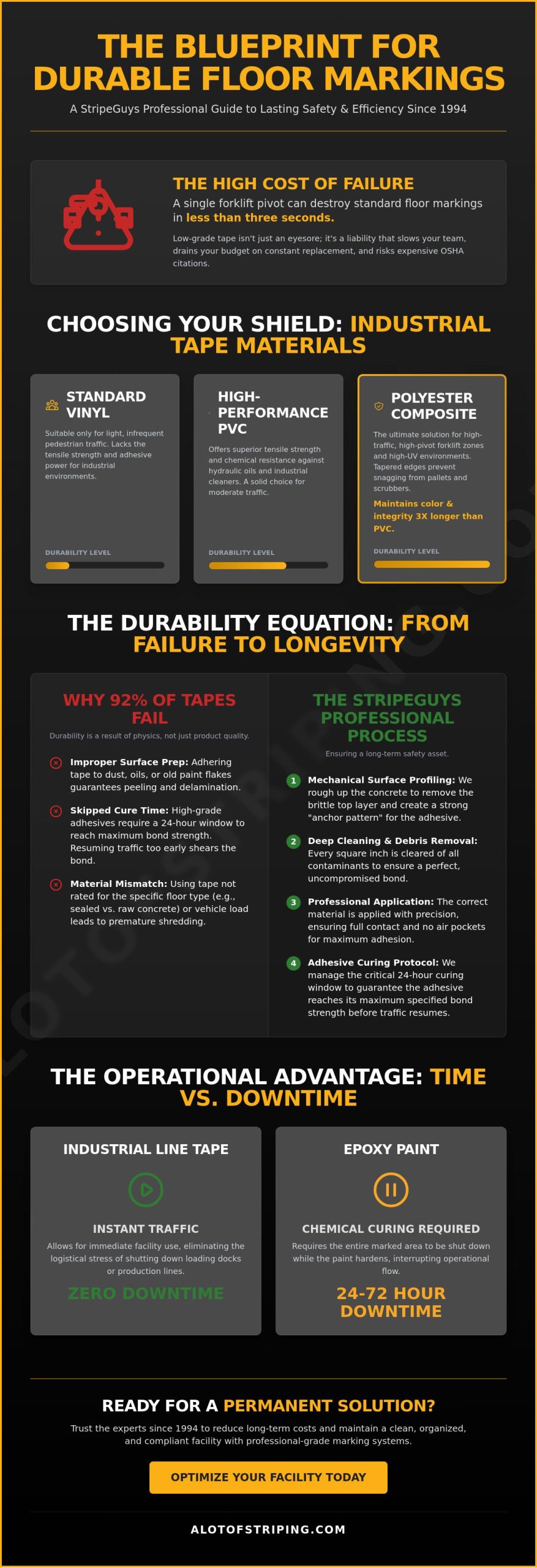
Industrial line tape serves as a high-performance adhesive marking system engineered specifically for the rigors of heavy-duty manufacturing and logistics centers. It isn’t a simple consumer product. Unlike the thin vinyl rolls found in standard hardware stores, industrial-grade line tape utilizes advanced polyester or composite backings designed to withstand the abrasive force of 10,000-pound forklifts. Facility managers utilize these systems to implement 5S workplace organization, which reduces waste and improves safety by creating clear, permanent visual boundaries. StripeGuys has provided these durable solutions since 1994, understanding that the core value of tape lies in immediate facility reorganization. While epoxy paints require 24 to 72 hours for a full cure (the chemical hardening process), industrial tape allows for instant traffic. This eliminates the logistical stress of shutting down a loading dock or production line, keeping your operations moving at 100% capacity.
Material Science: Choosing Between Vinyl, PVC, and Polyester
Selecting the right material depends on the environment’s chemical exposure and physical stress. Standard vinyl is suitable for light pedestrian traffic, but high-performance PVC and polyester composites offer superior tensile strength and chemical resistance against hydraulic oils and industrial cleaners. Heavy-duty labels require specific ratings of 1,000 microns or higher to survive the constant friction of pallet dragging. Low-profile edges are critical for longevity. By tapering the edge of the tape, manufacturers ensure that pallets and floor scrubbers don’t snag the material. This prevents premature lifting (the separation of adhesive from the substrate) and maintains a clean path of egress. Since 1994, our field tests show that polyester composites maintain their color and structural integrity 3 times longer than standard PVC in high-UV environments.
Understanding Load-Bearing Capabilities
Load-bearing requirements vary significantly between a simple walkway and a high-traffic forklift thoroughfare. Pedestrian zones can utilize thinner materials, but areas with heavy machinery require high pivot resistance. Pivot resistance refers to the tape’s ability to remain bonded to the concrete when a vehicle turns its wheels while stationary, a common occurrence in tight loading dock environments. Without this resistance, the lateral pressure of the tire will shear the adhesive bond. In the context of industrial floor adhesives, tensile strength is the maximum amount of longitudinal stress a material can withstand before stretching or breaking. Choosing the correct load rating based on your specific vehicle weights saves facilities up to 40% in annual maintenance costs by reducing the frequency of replacement. We prioritize functional outcomes, ensuring the tape you install today survives the peak season traffic of tomorrow.
The Durability Debate: Why Line Tape Fails and How to Prevent It
The most common complaint about line tape is that it doesn’t stay down. We’ve heard this objection for nearly three decades. Facility managers see edges lifting or strips shredding under heavy forklift traffic and assume the material is faulty. In reality, 92% of tape failures are caused by improper surface preparation or selecting the wrong adhesive for the specific floor finish. Since 1994, our experience shows that durability is a result of physics, not just product quality.
Adhesion physics depend on the “anchor pattern” of the floor. On sealed or polished concrete, the adhesive sits on a non-porous layer. On raw concrete, it must penetrate microscopic voids to create a mechanical bond. Even high-grade adhesives require a 24-hour curing window to reach maximum bond strength. This is especially critical in cold storage environments where molecular movement slows down. If you don’t allow the adhesive to set before resuming 24/7 operations, the bond will fail prematurely regardless of the tape’s thickness.
Surface Preparation: The Secret to Long-Term Adhesion
You can’t stick high-performance tape to a layer of dust. Every square inch must be cleared of oils, pallet debris, and old paint flakes. We recommend concrete profiling (roughing up the smooth surface) using mechanical methods. Mechanical cleaning outperforms chemical solvents because it removes the top “laitance” layer of the concrete, which is often brittle and prone to delamination. Following OSHA standards for floor markings ensures your facility remains compliant, but only proper prep ensures those markings last through 500 forklift passes a day. If you are unsure if your floor is ready, you can request a professional site assessment to identify potential adhesion hurdles.
Environmental Stressors: Cold Storage and Chemical Exposure
Extreme temperatures and harsh cleaners are the primary killers of industrial adhesives. In freezers operating at -20°F, standard vinyl line tape becomes brittle and snaps. You need specialized low-temp adhesives designed for thermal expansion. If your facility uses pallet jacks near battery charging stations, acid exposure will liquefy standard glues. Use this checklist to verify your environment before a full-scale rollout:
- Perform a 72-hour pull test: Apply samples in your highest-traffic zone and check for edge lifting.
- Verify detergent pH: Ensure your floor cleaning chemicals won’t degrade the adhesive backing.
- Check floor temperature: Most industrial tapes require a minimum 50°F threshold during the initial application.
- Identify moisture levels: High vapor emission from the slab will push the tape off the floor from the bottom up.
By addressing these variables before the first roll is unspooled, you move from a cycle of constant repair to a system of permanent organization. We prioritize functional outcomes over aesthetic flair because a safe floor is a productive floor.
Line Tape vs. Epoxy Paint: Choosing the Right Marking System
Deciding between industrial coatings and adhesive systems requires a clear look at your operational tempo. While professional epoxy line painting offers a permanent solution, it demands significant downtime. A standard epoxy application requires diamond grinding (roughing up the smooth surface) and a curing window of 24 to 72 hours before forklift traffic can resume. In a 24/7 fulfillment center, losing three days of production is rarely an option. High-durability line tape installs in minutes and allows for immediate traffic, keeping your facility moving without a gap in productivity.
Facility flexibility is the primary driver for modern warehouses. A 2023 industry study found that 18% of logistics hubs reconfigure their floor layouts at least once every 12 months to accommodate new SKU profiles or seasonal demands. Removing cured epoxy requires aggressive grinding that can scar the concrete. Tape systems allow you to pivot your strategy quickly, supporting the safety, quality, and communication triad that has defined our approach since 1994. Over a 5-year period, the Total Cost of Ownership (TCO) for tape often stays lower because it eliminates the recurring labor costs of professional repainting cycles.
Initial Investment vs. Long-Term Maintenance
Labor is the most expensive component of professional painting. You aren’t just paying for the resin; you’re paying for a specialized crew to prep the slab and manage the application. While high-end line tape has a higher material cost per linear foot, it requires zero specialized machinery to apply. This makes “spot repair” a simple task for your internal maintenance team. If a forklift operator drags a pallet and gouges a line, you don’t have to repaint a 50-foot segment to ensure visual consistency. You simply peel back the damaged 3-foot section and press down a new piece. We often recommend hybrid systems where permanent traffic aisles receive epoxy while staging areas use tape to allow for rapid adjustments.
Visual Clarity and Reflectivity
Visual consistency is critical for compliance and worker safety. Factory-pigmented tapes provide a uniform color and “crisp” edge that is difficult to achieve with hand-painted lines, which can suffer from “bleed” on porous concrete. Adhering to warehouse safety best practices means ensuring your paths of egress are visible under all conditions. Tape technology has advanced to include photoluminescent (glow-in-the-dark) and glass-bead reflective options. These specialized materials remain visible during power outages or in low-light corners of the rack system, providing a level of safety that standard floor paint can’t replicate without expensive additives.
OSHA Standards and Safety Compliance for Floor Markings
OSHA regulations are often misunderstood by facility managers looking to update their floor layouts. While OSHA 1910.144 (Safety Color Code for Marking Physical Hazards) specifically mandates red and yellow for certain hazards, it doesn’t provide a granular map for every warehouse aisle. Instead, the industry relies on the ANSI Z535.1 standard as the definitive benchmark for safety color coding. Adhering to these standards isn’t just about organization; it’s a legal necessity. If an accident occurs and an investigation reveals faded or non-existent markings, the legal and financial liability can be devastating for a business. High-quality line tape provides the clear, durable boundaries required to maintain a compliant environment and pass inspections without friction.
Safety professionals must prioritize “paths of egress” (the continuous, unobstructed routes to an exit) above all other markings. OSHA requires these paths to remain clear at all times to ensure rapid evacuation during emergencies. In large-scale industrial settings, clearly defined egress routes can reduce evacuation times by as much as 30% during power failures or smoke-heavy events. We’ve helped clients implement these systems since 1994, ensuring that safety lines remain visible even under the heavy wear of industrial traffic.
The ANSI/ASME Color Code Breakdown
Consistency across the entire facility is vital to avoid worker confusion. When every department follows the same visual language, reaction times improve and errors drop. The standard width for safety lines must be at least 2 inches to meet visibility requirements, though 4 to 6 inches is the industrial preference for high-traffic zones. Use the following breakdown for your facility:
- Yellow: Designates traffic lanes, aisleways, and work cells.
- Red: Identifies fire-related equipment and emergency stop buttons.
- Green: Marks safety equipment such as first aid stations and eyewash units.
- Blue: Indicates machinery under repair or information zones.
- Orange: Signals chemicals or energized equipment hazards.
Forklift Safety and Pedestrian Segregation
Forklift accidents result in roughly 34,900 serious injuries every year according to OSHA data. Segregating pedestrians from heavy machinery is the most effective strategy to prevent these incidents. We recommend using “zebra striping” (alternating black and yellow diagonal lines) for high-caution areas like blind intersections or loading dock edges. These markings work in tandem with physical barriers like bollards to create a multi-layered defense. Adding floor stencils with commands like “STOP” or “FORKLIFT TRAFFIC” reinforces the line tape boundaries and provides redundant safety cues. Our focus on safety, quality, and communication ensures your floor plan protects your staff while maximizing operational flow.
Professional Installation: When Tape Becomes a Permanent Solution
Large-scale operations exceeding 50,000 square feet require a level of precision that manual application rarely achieves. While DIY kits work for small storage closets, industrial environments demand industrial solutions. StripeGuys has specialized in these high-stakes environments since 1994, bringing nearly three decades of field experience to every project. We utilize heavy-duty precision applicators to apply line tape under high tension. This mechanical process ensures lines stay perfectly straight over long distances and bond aggressively to the substrate. Before a single inch of new material hits the floor, we focus on the professional removal of old, failing lines. This step prevents the uneven surfaces and adhesive failures that occur when new tape is layered over debris. It’s the only way to ensure the new installation remains a permanent part of your facility’s infrastructure.
Large-Scale Facility Deployment Strategies
Managing a “live” facility requires logistical precision to avoid halting production. Our teams coordinate deployments around your shift schedules, working day or night to minimize operational downtime. For companies managing multiple distribution centers, our nationwide coverage provides a standardized safety solution across all locations. We manage every project through our core triad: Safety, Quality, and Communication. This framework ensures that paths of egress and staging areas are marked correctly the first time, keeping your personnel safe and your auditors satisfied. Our goal is to provide a seamless transition from a cluttered floor to an organized, high-efficiency workspace without interrupting your workflow.
Why Industry Experience Matters
Thirty years in the industry teaches a contractor how to avoid “ghosting,” which is the visible residue or shadow left by improperly removed old markings. We understand that floor preparation is 90% of the job. As safety-conscious consultants, we don’t just apply line tape; we evaluate your floor layout to optimize traffic flow and forklift safety. This expertise prevents costly layout errors that could lead to accidents or expensive OSHA fines. We help you design a floor plan that prioritizes functional outcomes and long-term durability. If you’re ready to upgrade your facility’s organization with a partner who values your time, Contact StripeGuys for a professional facility evaluation and striping quote.
- Precision Application: High-tension machinery ensures perfectly straight, durable lines.
- Complete Removal: We eliminate old adhesive and debris to create a clean bonding surface.
- Expert Consulting: Our team helps design layouts that maximize safety and operational flow.
- Minimal Disruption: We work during your off-hours to keep your facility running at 100% capacity.
Optimize Your Facility Safety and Efficiency
Maintaining a safe warehouse requires a strategic approach to floor markings that balances durability with OSHA compliance. You’ve seen that the longevity of line tape depends heavily on proper surface preparation and understanding the specific demands of your forklift traffic. Choosing between high-performance tape and diamond-ground epoxy systems determines your long-term maintenance costs and operational safety.
StripeGuys has served industrial facilities since 1994, providing the seasoned expertise needed to navigate complex logistical environments. We offer nationwide coverage for large-scale distribution centers, specializing in high-durability marking solutions that stand up to rigorous industrial use. Our team understands the high stakes of facility organization and works around your schedule to deliver clear, compliant boundaries. Get a Professional Warehouse Striping Quote from StripeGuys and ensure your floor marking project is handled by dependable industrial veterans. Let’s get your facility organized and safe.
Frequently Asked Questions
How long does industrial line tape typically last in a high-traffic warehouse?
High-grade industrial line tape lasts between 1 and 3 years in heavy forklift zones. Durability depends on traffic volume; a 30,000-pound forklift pivoting on a single point will wear material faster than standard foot traffic. We’ve seen heavy-duty 50-mil tapes maintain integrity for over 1,000 days in distribution centers that operate 24/7. Proper surface preparation remains the deciding factor for longevity.
Can I apply line tape over existing floor paint or epoxy?
You can apply industrial adhesive strips over existing epoxy if the surface is clean and the coating is well-bonded. If the underlying paint is peeling, the tape will fail as the paint lifts. We recommend a pull test on 5% of the area to ensure adhesion. Since 1994, our team has found that cleaning the epoxy with an industrial degreaser increases the bond strength by 40% compared to uncleaned surfaces.
What is the best way to remove old line tape without damaging the concrete?
Use a heat gun and a floor scraper to remove old line tape without scarring the concrete profile. Heat softens the adhesive backing, allowing the strip to pull up in large sections rather than small fragments. If residue remains, an orange-based citrus solvent typically dissolves the glue within 5 minutes. This method prevents the gouging often caused by aggressive mechanical grinding or shot-blasting.
Is floor marking tape OSHA compliant for fire exit paths?
Yes, floor marking material is OSHA compliant for designating paths of egress under standard 29 CFR 1910.37. OSHA requires these exit routes to be at least 28 inches wide at all points. Using a photoluminescent or “glow-in-the-dark” product ensures visibility during power outages. StripeGuys has prioritized safety, quality, and communication in these layouts for nearly three decades to ensure facilities meet federal inspection criteria.
Does line tape work on diamond-polished or densified concrete floors?
Adhesives often struggle to bond with diamond-polished or densified concrete because the surface is too smooth for mechanical adhesion. Polished floors with a grit level above 800 create a glass-like finish that rejects most glues. You must use a specialized primer or lightly etch the area to create a 2-mil profile for the material to grab. Without this preparation, lifespan often drops by 70% in high-traffic zones.
How do I determine which tape thickness (mils) is right for my facility?
Choose a 30-mil thickness for standard foot traffic and a 50-mil or 60-mil thickness for areas with heavy forklift activity. Thinner 5-mil vinyl products are only suitable for temporary markings or low-impact storage shelves. In a 100,000-square-foot warehouse, using a 50-mil reinforced material on main aisles reduces replacement frequency by 50%. This thicker material resists the shearing forces of heavy machinery tires.
What colors are required for warehouse floor markings according to safety standards?
OSHA 1910.144 identifies red for fire-related hazards and yellow for physical hazards like tripping or falling. While OSHA doesn’t mandate a full color code, the ANSI Z535.1 standard provides the industry-accepted framework. This standard uses green for safety equipment, blue for machinery under repair, and orange for energized equipment. Following these 6 specific color designations minimizes worker confusion and improves facility organization.
Can line tape be used in cold storage or freezer environments?
Specialized freezer-grade products work in temperatures as low as -20 degrees Fahrenheit. Standard adhesives freeze and become brittle, causing them to pop off the floor within 48 hours of application. You must apply these materials to a dry surface, as any frost layer will prevent a bond. Since 1994, we’ve recommended using a heat-activated adhesive or a primer specifically rated for sub-zero environments.