
If your floor markings are peeling after only six months of heavy forklift traffic, you didn’t just buy a bad paint job; you invested in a safety liability that will likely trigger an OSHA citation during your next inspection. We know that maintaining a 24/7 facility requires markings that work as hard as your crew does. Since 1994, our team has seen how poor preparation leads to failed warehouse floor painting projects that disrupt production and waste maintenance budgets. You deserve a professional solution that prioritizes long-term durability over a quick, temporary fix.
This guide provides the technical blueprint for executing a high-durability project that survives 10,000-pound forklift loads and maintains clear paths of egress (designated exit routes). You’ll master the essential steps of diamond grinding (using industrial abrasives to open the concrete pores) and selecting high-performance epoxies that bond permanently to the substrate. We will detail the specific preparation methods and application strategies needed to achieve full OSHA compliance while minimizing operational downtime in your facility.
Key Takeaways
- Understand why warehouse floor painting is a safety-critical infrastructure investment rather than an aesthetic choice, requiring industrial-grade coatings for high-traffic environments.
- Discover why mechanical surface preparation, specifically concrete profiling (roughing up the smooth surface), is the non-negotiable foundation for a long-lasting bond.
- Evaluate the total cost of ownership for striping materials by applying the “forklift test” to measure durability against tire friction and skidding.
- Standardize your facility’s layout using specific color codes to ensure full compliance with OSHA 1910.176(a) regulations for permanent aisles and passageways.
- Identify the technical benchmarks for selecting a reliable contractor, such as verifying their direct ownership of specialized shot blasters and diamond grinders.
What is Industrial Warehouse Floor Painting?
Industrial warehouse floor painting is a critical safety infrastructure component rather than a simple aesthetic choice. At StripeGuys, we’ve provided these essential services since 1994, understanding that a facility’s floor is its most active piece of equipment. Unlike standard commercial paint found in retail spaces, high-performance industrial coatings are engineered to withstand the relentless friction of 10,000-pound forklifts and chemical spills. This specialized application creates a predictable environment where workers can navigate safely and efficiently.
The implementation of clear markings is a cornerstone of lean manufacturing and 5S organizational methodologies (Sort, Set in order, Shine, Standardize, Sustain). By defining exact locations for every pallet and tool, facilities can see a 25% increase in operational throughput by reducing “search time” for employees. While some facilities rely on temporary Floor Marking Tape for short-term projects, permanent warehouse floor painting provides the long-term durability required for 24/7 operations. According to 2021 OSHA data, approximately 95,000 forklift accidents occur annually; clear, high-contrast floor lines are a primary defense against these incidents by separating human and machine traffic.
Key Functions of Floor Markings
- Safety Zones: Defining pedestrian walkways and paths of egress (emergency exit routes) to keep workers away from heavy machinery.
- Traffic Patterns: Designating forklift lanes and two-way traffic aisles to prevent collisions in high-speed loading docks.
- Hazard Identification: Marking restricted areas around electrical panels, fire extinguishers, and chemical storage to ensure compliance with safety codes.
Common Materials: Epoxy vs. Alkyd vs. Polyurethane
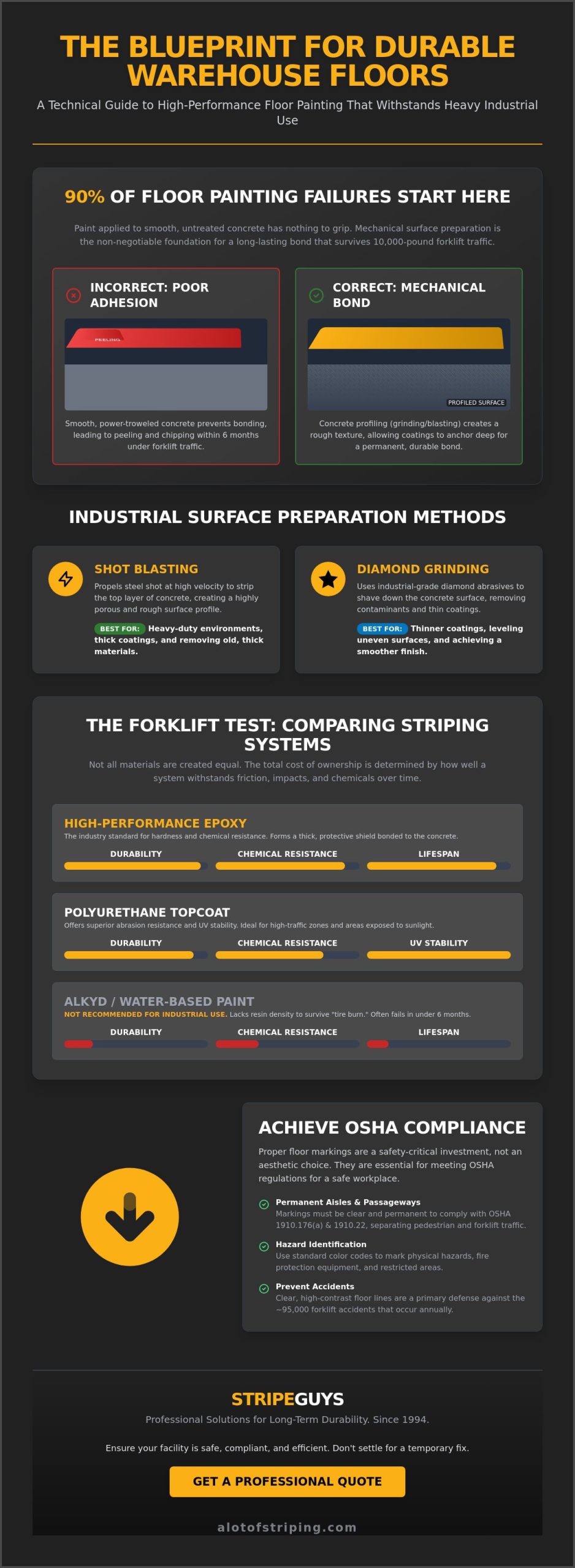
Choosing the right material determines the lifespan of your investment. Epoxy is the industry standard for hardness and chemical resistance (the ability to withstand oil and solvent spills). It creates a dense, protective shield that bonds to the concrete substrate. Polyurethane offers superior UV stability and abrasion resistance, making it ideal for high-traffic areas near bay doors where sunlight might cause other paints to yellow or brittle. We typically advise against alkyd or water-based paints in industrial settings. These materials lack the resin density to survive forklift “tire burn” and often peel within 6 months of application, leading to higher long-term maintenance costs and increased logistical stress for facility managers.
Our commitment to safety, quality, and communication ensures that every warehouse floor painting project we undertake meets the rigorous demands of modern logistics. We prioritize functional outcomes, focusing on how the floor performs under pressure rather than just how it looks on day one.
The Science of Adhesion: Why Surface Preparation is Non-Negotiable
The primary reason 90 percent of warehouse floor painting projects fail prematurely isn’t the quality of the resin, but a lack of mechanical bond. Paint applied to a smooth, power-troweled concrete slab has nothing to grip, causing it to peel under the weight of a 10,000-pound forklift. Since 1994, StripeGuys has prioritized the physical chemistry of the slab over the speed of the application. We utilize concrete profiling, which involves roughing up the smooth surface to create a texture that accepts industrial coatings. This process removes latent contaminants like deep-seated oils, dust, and old sealers that act as a barrier to adhesion. Our approach relies on the safety, quality, and communication triad to ensure your facility meets OSHA 1910.22 requirements for clear and permanent marking of aisles and passageways.
Mechanical Removal Methods
We select preparation methods based on the specific needs of your slab. Shot blasting is the gold standard for heavy-duty environments; it uses centrifugal force to propel steel shot at the floor, stripping away the top layer and creating a high-profile texture. For projects requiring a smoother finish or thinner coatings, we use diamond grinding. This method uses industrial-grade diamonds to shave down high spots and remove thin-film coatings while leveling the surface. We generally advise against chemical etching for industrial use. This DIY-style method involves acid wash that often fails to provide the depth of profile needed for heavy forklift traffic and can leave behind moisture that ruins the bond.
Addressing Existing Line Removal
Painting over old, flaking lines is a recipe for disaster because the new paint is only as strong as the failing layer beneath it. We employ dustless removal techniques using HEPA-filtered vacuums, which is critical for food-grade or pharmaceutical facilities where airborne particles are a safety hazard. Before we apply the first drop of paint, we address surface integrity by patching cracks and pits that could catch a pallet jack wheel. This meticulous preparation is why facility managers trust our specialized team to deliver results that last for years rather than months. Durable markings begin with a clean, profiled foundation, ensuring your paths of egress remain visible and your investment remains protected against the daily grind of warehouse operations.
Comparing Warehouse Striping Systems: Paint vs. Epoxy vs. Tape
Selecting the right material for warehouse floor painting requires looking past the initial quote to the Total Cost of Ownership (TCO). While standard traffic paint costs less upfront, it often requires repainting every 12 to 18 months in high-traffic zones. In contrast, high-performance systems can last 5 to 7 years before needing a refresh. The “forklift test” is the ultimate decider for facility managers. A 10,000-pound forklift creates intense heat and friction during a pivot. Lower-grade paints will delaminate, which means the coating peels away from the concrete, under these extreme stresses.
Downtime is a major logistical hurdle that StripeGuys has managed for clients since 1994. Water-based paints may dry for foot traffic in 60 minutes, but they don’t offer long-term resilience. 100% solids epoxy requires a full 24-hour cure for light traffic and up to 72 hours for heavy machinery. For facilities handling hazardous materials, we recommend novolac epoxy. This specialized coating provides a high cross-link density that resists 98% sulfuric acid and other aggressive chemicals that would melt standard industrial paint.
- Initial Cost: Paint is lowest, Tape is moderate, Epoxy is highest.
- Durability: Epoxy leads the industry, lasting 5 times longer than paint.
- Downtime: Tape is instant, Paint takes 4 hours, Epoxy takes 24-72 hours.
Thin-Film Paint vs. High-Build Epoxy
Use thin-film paint for low-traffic staging areas where floor layouts change every few months. It provides a clean look without a heavy investment. For main travel aisles, 100% solids epoxy is the standard. It creates a “high-build” layer, typically 10 to 20 mils thick, that levels out minor floor imperfections. Epoxy maintains its high-gloss finish and color vibrance much longer than paint, which tends to chalk or fade under heavy scrubbing and constant warehouse floor painting maintenance cycles.
When to Use Industrial Floor Tape
Heavy-duty floor marking tape is a viable solution for facilities that require an immediate return to service. It’s useful for trial layouts, but tape struggles at pivot points. When a forklift operator turns the wheels while stationary, the torque often shears the adhesive from the floor. We often suggest a hybrid approach to balance safety, quality, and communication. Use tape for temporary seasonal storage layouts and reserve 100% solids epoxy for permanent paths of egress and primary safety zones that must withstand nearly three decades of wear.
Planning Your Layout for OSHA Compliance and Efficiency
Compliance begins with OSHA 1910.176(a). This regulation mandates that permanent aisles and passageways must be clearly marked to prevent accidents where mechanical handling equipment is used. In a high-traffic environment, warehouse floor painting serves as the primary visual communication tool for operators. Since 1994, our team has implemented layouts that prioritize the 34,900 serious forklift injuries OSHA reports annually as a reason for strict marking protocols. Clear boundaries aren’t just a legal requirement. They’re a functional necessity for maintaining peak operational speed.
- Yellow: The standard for traffic lanes, aisleways, and general work areas.
- Red: Identifies fire hazards, extinguishers, and emergency stop areas.
- Green: Marks first aid kits, safety showers, and paths of egress (exit routes).
- Black/Yellow: Warns of physical hazards like low-clearance beams or stairs.
Standard 4-inch lines provide the best balance of visibility and floor economy. While some facilities request 2-inch lines for tight racking or 6-inch lines for heavy-duty transit corridors, the 4-inch width remains the industry benchmark. Integrating stencils for pallet positions and bay numbers eliminates guesswork for workers. This level of detail reduces the 15 percent of warehouse time typically wasted on searching for misplaced inventory or navigating disorganized aisles.
Designing for Forklift and Pedestrian Segregation
Separating workers from heavy machinery requires more than a single line. We recommend 3-foot buffer zones between pedestrian paths and forklift lanes to account for load overhang. High-visibility crosswalks and stop bars at every intersection force operators to pause and check for foot traffic. Directional arrows are essential in narrow aisles to prevent head-on congestion. These markings act as a silent supervisor, ensuring safety even when floor managers aren’t present.
Logistics of a Professional Painting Project
A warehouse floor painting project shouldn’t halt your production. We utilize phased scheduling to keep your facility 100 percent operational during the installation. By working during night shifts or weekends, we ensure your peak-hour shipping remains unaffected. Our team manages ventilation and uses low-VOC (Volatile Organic Compound) coatings to keep the air safe for workers in enclosed spaces. We focus on our safety, quality, and communication triad to deliver results that don’t compromise your schedule.
Choosing a Warehouse Floor Painting Contractor
Verify that the contractor owns their equipment fleet. A professional industrial contractor maintains their own shot blasters and diamond grinders (heavy machinery used to profile the concrete surface). Relying on rental yards causes scheduling delays and often results in using dull tooling that won’t achieve the necessary Concrete Surface Profile (CSP) level. For multi-site logistics companies operating across several states, nationwide coverage is essential to maintain standardized safety markings across 15 or 20 facilities.
Questions to Ask Before Hiring
When evaluating warehouse floor painting bids, vet the provider’s technical depth with these specific inquiries:
- What is your specific process for surface preparation? If they don’t mention mechanical abrasion like shot blasting to remove laitance (the weak top layer of concrete), the coating will eventually fail.
- Can you provide references for projects over 100,000 linear feet? Large-scale logistics hubs require a different level of project management than small local shops.
- Do you offer a warranty against peeling or delamination? A reputable contractor stands behind their bond strength and application technique.
The StripeGuys Advantage: Trusted Since 1994
StripeGuys has served as a dependable industrial veteran for nearly three decades. Since 1994, we’ve navigated the complexities of high-traffic forklift environments, ensuring that every line is straight and every safety zone is visible. We prioritize functional outcomes over aesthetic flair, focusing on the physical realities of your 24/7 operation.
Our team operates on a triad of safety, quality, and communication. We keep managers informed at every step, from the initial diamond grinding to the final curing phase. We understand that downtime costs money, so we work around your schedule to minimize disruptions. You’ll have direct access to our team to ensure your project stays on budget and meets OSHA standards for paths of egress.
Contact StripeGuys for an industrial floor evaluation to see how our 30 years of experience can secure your facility.
Maximize Facility Safety and Operational Longevity
High-performance industrial environments demand more than just visual markings; they require a system built for the physical realities of heavy forklift traffic and strict OSHA compliance. Successful warehouse floor painting depends on two critical factors: choosing the right material for your specific traffic patterns and prioritizing mechanical surface preparation. Without diamond grinding (roughing up the smooth surface) to profile the concrete, even high-quality epoxy won’t bond correctly. This leads to peeling lines that compromise both safety and your maintenance budget.
Since 1994, StripeGuys has specialized in high-profile industrial projects across the United States. We focus on the technical details that matter, from precision line removal to the safety, quality, and communication triad that defines our process. Our team understands that paths of egress and clear boundaries aren’t just suggestions; they’re essential for 24/7 operational efficiency. When you partner with an industrial veteran, you’re investing in markings that withstand the rigors of a modern logistics hub. We’re ready to help you organize your facility with precision and authority.
Get a Professional Warehouse Striping Quote from StripeGuys
Your facility deserves a durable foundation that supports long-term growth and safety.
Frequently Asked Questions
How long does warehouse floor paint take to dry before forklifts can drive on it?
Forklift traffic requires a full cure time of 72 hours for high-build epoxy systems, though light foot traffic can often resume after 24 hours. Allowing the chemical bond to reach 100% hardness prevents delamination or “hot tire pickup” where heavy tires pull the coating from the substrate. We prioritize these specific timelines to ensure your warehouse floor painting investment lasts for its intended 5 to 10 year lifecycle.
What are the OSHA requirements for warehouse floor marking colors?
OSHA standard 1910.144 requires red for fire-related hazards and yellow for physical hazards like tripping or falling. While OSHA doesn’t mandate a full color palette, most industrial facilities follow ANSI Z535.1 standards, using green for safety equipment and blue for informational signs. We apply these 5 specific color codes to ensure your facility remains compliant during safety inspections and audits.
Is it better to use epoxy or paint for warehouse lines?
Industrial epoxy is the superior choice for warehouse lines because it creates a high-strength chemical bond with the concrete, whereas standard floor paint only sits on the surface. Epoxy coatings withstand 10,000 pound forklift loads and chemical spills that would cause standard paint to peel within 6 months. For high-traffic paths of egress, we recommend a 100% solids epoxy to maintain visibility and structural integrity.
How do you remove old warehouse floor markings without damaging the concrete?
Professional contractors use diamond grinding or shot blasting to remove old markings by mechanically “roughing up the smooth surface” without fracturing the concrete slab. These methods remove 100% of the old material while creating a CSP 2 or 3 (Concrete Surface Profile) which is essential for new coating adhesion. Avoid chemical strippers, as they often leave residues that interfere with the bonding of the new warehouse floor painting.
What is the average lifespan of professional epoxy floor striping?
Professional epoxy floor striping typically lasts between 3 and 5 years in high-traffic distribution centers operating 24/7. In lower-traffic storage zones, these markings can maintain 90% visibility for up to 10 years. Longevity depends on proper surface preparation, such as using a planetary grinder to remove laitance, which increases the striping lifespan by 300% compared to un-prepped surfaces.
Can you paint warehouse floors in cold storage or freezer environments?
You can paint warehouse floors in cold storage environments using specialized polyaspartic coatings that cure at temperatures as low as -20 degrees Fahrenheit. Standard epoxies fail to cure below 50 degrees, so we utilize rapid-cure technology to ensure the bond forms correctly without shutting off your refrigeration systems. This specialized approach allows for safety marking installation in 0-degree freezer zones without compromising the thermal envelope.
Do I need to shut down my warehouse during the painting process?
You don’t need to shut down your entire facility because we offer night and weekend scheduling to keep your operations running. Since 1994, we’ve refined a phased implementation strategy where we section off 20% of the floor at a time. This allows your team to maintain 80% of their operational capacity while we complete the installation of durable markings and safety zones.
How wide should warehouse pedestrian walkways be?
Pedestrian walkways should be at least 36 inches wide to meet basic safety standards, though we recommend 42 to 48 inches for optimal two-way traffic flow. This width ensures that staff can safely navigate past racking and machinery while maintaining a 12-inch buffer from forklift travel lanes. Clear boundaries reduce workplace accidents by 25% by providing predictable paths of egress for all employees.