
If you think the most expensive part of your 2026 facility budget is the paint itself, you’re looking at the wrong line item. According to OSHA, nearly 20% of all warehouse injuries involve forklifts, a statistic that underscores the high stakes of poorly defined traffic lanes. You likely already realize that faded, peeling lines aren’t just an eyesore; they’re a liability that slows down your operators and risks heavy non-compliance fines. When you ask how much does it cost to stripe a warehouse, you’re really asking how to balance long-term durability with immediate operational uptime.
StripeGuys has served as a trusted industrial partner since 1994, and we understand that transparency is the foundation of a successful project. This guide provides a clear breakdown of industrial striping costs, covering everything from diamond grinding (roughing up the smooth surface) to selecting a durable novolac epoxy. We’ll examine material life cycles, surface preparation requirements, and how to build an accurate budget that avoids hidden fees. You’ll learn exactly how to secure paths of egress and safety zones without disrupting your 24/7 production schedule.
Key Takeaways
- Identify the core pillars of industrial estimates, including how linear footage and surface condition (the physical profile of your concrete) dictate 2026 budget requirements.
- Determine exactly how much does it cost to stripe a warehouse by comparing the initial price versus the long-term durability of traffic paint, epoxy, and polyurethane.
- Uncover the critical role of surface preparation, such as diamond grinding for line removal, to prevent premature coating failure and ensure a professional bond.
- Learn why prioritizing low-cost materials often triples long-term expenses due to frequent re-application and increased operational downtime in high-traffic forklift environments.
- Leverage StripeGuys’ nearly three decades of industrial expertise to implement a “Safety, Quality, and Communication” strategy that protects your facility’s ROI.
Understanding Warehouse Striping Costs: More Than Just Paint on Concrete
Determining how much does it cost to stripe a warehouse requires looking beyond the price per linear foot. Since 1994, we’ve seen facility managers struggle with budgets because they view striping as a simple aesthetic upgrade rather than critical safety infrastructure. A professional estimate is a combination of high-performance materials, expert labor, and mechanical surface preparation (the process of diamond grinding to “rough up” the smooth concrete surface for better adhesion). Choosing a “cheap” contractor often results in paying 3x more over three years because inferior traffic paint flakes off under the weight of a 10,000-pound forklift within months.
The primary objective of any striping project is the creation of durable paths of egress and permanent safety zones. These lines must withstand constant abrasion, tire scrubbing, and chemical spills. Total project costs fluctuate based on facility size and layout complexity. A 500,000-square-foot distribution center with intricate 5S patterns requires significantly more precision and time than a standard storage grid. Adhering to Floor Marking Tape Standards and professional industrial painting guidelines ensures that your facility remains organized and compliant from the first day of operations.
Initial Price vs. Total Cost of Ownership (TCO)
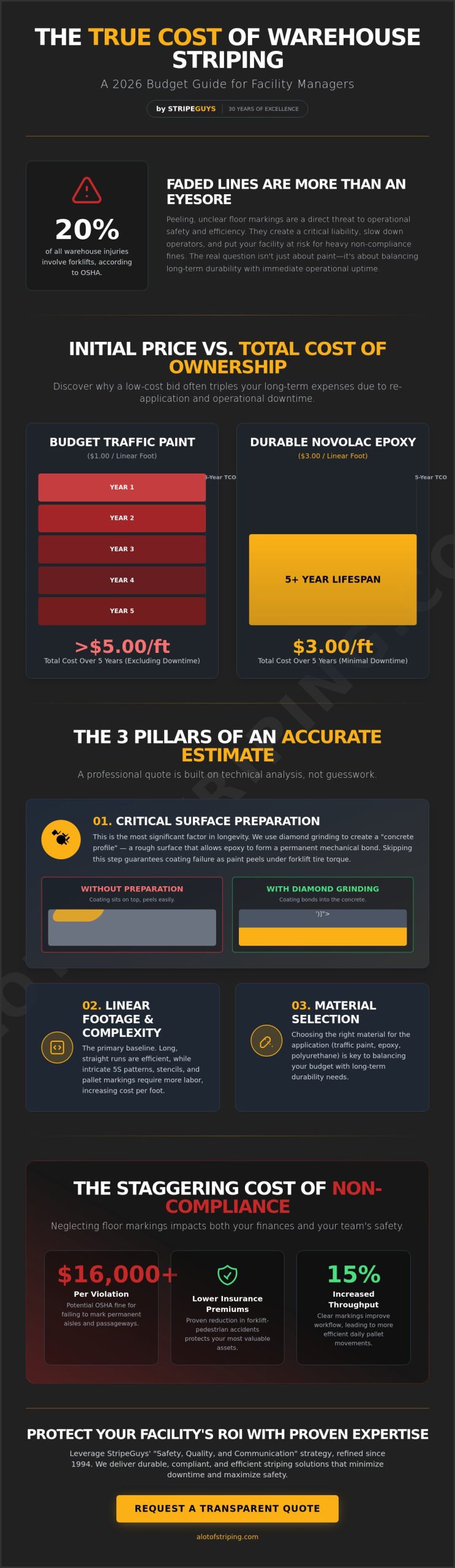
Total Cost of Ownership (TCO) is the most accurate way to measure industrial floor marking expenses. TCO measures the total investment over the marking’s lifecycle, including maintenance and replacement. For example, a budget-tier $1.00 per foot job that requires yearly re-application is far more expensive than a $3.00 per foot epoxy system that lasts 5 years. When you factor in the operational downtime needed to clear racks and move inventory for frequent repainting, the “expensive” option usually saves thousands of dollars in long-term facility costs.
The Cost of OSHA Non-Compliance
Neglecting floor markings carries a heavy price tag in the form of federal fines and legal liability. OSHA frequently cites warehouses for failing to mark permanent aisles and passageways, with 2024 penalties often exceeding $16,000 per violation for serious infractions. Beyond fines, clear striping is a proven method for reducing forklift-pedestrian accidents, which protects your most valuable assets and lowers insurance premiums. High-visibility markings also improve facility throughput. When operators don’t have to guess where to stage pallets or drive, the entire workflow becomes more efficient, often resulting in a 15% increase in daily pallet movements.
The Three Pillars of Industrial Striping Estimates in 2026
Determining how much does it cost to stripe a warehouse requires a technical analysis of three specific variables: footage, preparation, and timing. These pillars dictate the total investment for any facility manager seeking a durable, compliant layout. Since 1994, our experience shows that accurate estimates rely on physical site conditions rather than simple square footage guesses. We prioritize functional outcomes that stand up to heavy forklift traffic and rigorous cleaning schedules.
Linear Footage and Layout Complexity
Linear footage serves as the primary baseline for every professional quote. Long, straight runs for travel lanes are more efficient to install, resulting in a lower price per foot compared to intricate stenciling. Facilities exceeding 50,000 square feet typically benefit from economies of scale because mobilization time is spread across a larger volume of work. Pallet position markings and custom safety symbols require more manual labor and precision, which increases the total project cost. If you need a comprehensive layout, requesting a detailed site map review helps ensure your estimate reflects actual labor requirements.
The Critical Role of Surface Preparation
Surface preparation is the most significant factor in striping longevity. Professional contractors prioritize concrete profiling, which involves “roughing up the smooth surface” to create a mechanical bond for the epoxy. Without this step, coatings simply sit on top of the concrete and peel under the torque of forklift tires. We compare methods like shot blasting and diamond grinding to determine the best path for line adhesion. This technical process ensures your facility remains compliant with OSHA’s General Requirements (1910.22) for clearly marked aisles and passageways. While prep work increases the initial price, it prevents the recurring expense of annual re-striping.
Mobilization and Access Fees
Operational windows significantly impact the final number when calculating how much does it cost to stripe a warehouse in 2026. Clear, empty floors allow our teams to work at maximum speed, often reducing labor costs by 20 percent or more. In contrast, active 24/7 hubs often require phased installations or night and weekend shifts. These “off-hour” mobilizations carry a premium to cover specialized scheduling and rapid-cure materials like novolac epoxy. For companies managing multi-facility portfolios, national contracts offer a way to standardize these costs and ensure consistent safety standards across different regions. We focus on minimizing your operational downtime while delivering high-performance paths of egress and durable safety zones.
Material Selection: Comparing Initial Price vs. Durability
Choosing the right material directly dictates your long-term ROI. When facility managers ask how much does it cost to stripe a warehouse, they often focus on the initial quote. However, the true cost includes the frequency of restriping and operational downtime. Since 1994, we’ve seen that the cheapest paint often ends up being the most expensive choice over a five-year period. Compliance with OSHA regulation 1910.176 requires clear marking of permanent aisles and passageways where mechanical handling equipment is used. Failing to maintain these lines creates safety hazards and legal liabilities that far outweigh the cost of premium materials.
Industrial Traffic Paint: The Budget-Friendly Starter
Traffic paint is a water-based or solvent-based solution best suited for low-traffic zones or facilities with evolving layouts. It’s the most affordable entry point but lacks the bond strength of high-end systems. In a standard distribution center, these lines typically last 6 to 12 months before showing significant wear. This material is highly susceptible to ghosting (the faint, messy remains of old lines) and tire marks from heavy machinery. Use this for temporary staging areas where flexibility is more important than permanent longevity.
Epoxy and Polyurethane: The High-Performance Gold Standard
For nearly three decades, we’ve recommended 2-part epoxy systems as the preferred choice for high-volume facilities. These materials physically bond to the concrete through a chemical reaction. This makes them resistant to forklift scrubbing (the abrasive force of tires turning in place). Adding a polyurethane topcoat or a densifier (a chemical sealer that hardens the concrete surface) can extend the life of your lines to 5 years or more. For environments handling harsh cleaners or acids, we utilize Novolac epoxy to provide specialized chemical resistance that standard coatings cannot match. When calculating how much does it cost to stripe a warehouse, consider that these systems require diamond grinding (roughing up the smooth surface) to ensure a permanent bond.
Floor Tapes and LED Projections
Heavy-duty floor tapes offer a tactical solution for areas requiring immediate use. Unlike paint, tape requires zero cure time (the period needed for a coating to dry and harden). This prevents the indirect cost of halting operations for 12 to 24 hours. Tape is excellent for straight runs but can peel in high-pivot areas. In environments with extreme heat or constant moisture where no physical paint survives, LED projected lines offer a permanent solution. While the initial hardware investment is higher, the lack of maintenance provides a clear ROI for 24/7 operations where floor coatings fail prematurely.
- Traffic Paint: Best for 1-year cycles and low-impact zones.
- Epoxy: The industry standard for 3 to 5-year durability.
- Novolac: Essential for chemical manufacturing and battery storage.
- LED: High upfront cost with zero maintenance for high-stress zones.
Hidden Costs and Budgeting Traps to Avoid
Calculating how much does it cost to stripe a warehouse requires looking beyond the base price per linear foot. Since 1994, StripeGuys has observed that facility managers often overlook the physical state of their concrete, which leads to unexpected change orders. If your floor has existing markings or structural damage, the initial quote will fluctuate based on the labor required to prepare a bondable surface. Our team prioritizes functional outcomes, meaning we won’t just paint over a problem that will peel in six months.
Warehouse Line Removal Services
Painting over old, flaking lines is a waste of your maintenance budget. New epoxy or paint cannot bond to a failing substrate. We utilize mechanical removal techniques like shot blasting or diamond grinding (roughing up the smooth surface) to ensure the new material integrates with the concrete pores. In food-grade facilities, 95% of removal projects require dustless HEPA-filtered vacuum systems to prevent contamination of inventory. This specialized equipment ensures safety and air quality, though it requires more setup time than standard grinding.
Surface Preparation and Cleaning
Clean and dry is the absolute minimum requirement for any industrial project. Oil-soaked concrete in maintenance bays or manufacturing zones prevents marking adhesion entirely. To solve this, we use industrial-strength degreasers and mechanical scrubbing machines to draw contaminants out of the slab. Ignoring these hot spots means your paths of egress will peel within weeks. Proper preparation ensures the durability our clients have trusted for nearly three decades. We focus on the physical realities of forklift environments to ensure your lines stay visible under heavy use.
The DIY trap is another common budgeting error. Renting a striping machine and using hardware-store paint might seem cost-effective on a spreadsheet. However, consumer-grade paints lack the solids content found in professional novolac epoxy or polyaspartic coatings. While a professional application might last five years in a high-traffic forklift zone, a DIY application often fails in 12 weeks. You end up paying twice: once for the failed attempt and once for the professional removal and re-application. When you consider how much does it cost to stripe a warehouse, you must factor in the longevity of the materials used.
- Travel and Logistics: Remote industrial sites located more than 50 miles from a major metro hub often incur mobilization fees to cover fuel and technician transit time.
- Concrete Repair: Pitting and cracks should be filled with a rigid epoxy joint filler before striping to prevent the paint from sinking into the floor.
- Moisture Testing: High moisture vapor transmission in a slab can cause epoxy to blister, requiring a specialized moisture-mitigating primer.
Our safety, quality, and communication triad ensures that every hidden cost is identified before the first drop of paint hits the floor. Contact our warehouse striping experts to get a transparent, all-inclusive project estimate today.
Maximizing ROI with StripeGuys’ National Expertise
Managing a high-volume distribution center requires precision; every square foot of floor space must contribute to your bottom line. When facility managers ask how much does it cost to stripe a warehouse, they should consider the long-term return on investment rather than just the initial invoice. A cheap application that peels within six months effectively doubles your costs. StripeGuys protects your budget by applying nearly three decades of industrial experience to every project, ensuring that your safety markings withstand heavy forklift traffic and 24/7 operations.
Our project management strategy centers on our core triad: Safety, Quality, and Communication. This framework ensures we meet OSHA standards while keeping your facility operational. We coordinate closely with your floor managers to schedule work during low-traffic windows or weekend shifts. This strategic planning minimizes downtime, which is often the most significant hidden cost of any facility upgrade. For companies with locations in multiple states, our nationwide coverage guarantees 100% branding consistency. Regardless of your facility’s location, your paths of egress and staging lanes will look identical and meet the same high-durability standards. To further enhance your company’s professional identity alongside these physical safety upgrades, SwagStore.NET offers bulk custom-branded merchandise and corporate gifts that help maintain a consistent brand image for your entire workforce.
Why 29+ Years of Experience Matters
We’ve been refining our processes since 1994. This longevity means our veteran teams have encountered every concrete failure imaginable, from moisture vapor transmission to surface carbonation. We understand that success depends on concrete profiling, which involves “roughing up the smooth surface” to ensure a mechanical bond. We don’t just paint lines; we engineer a durable surface solution using industrial-grade materials like low-VOC epoxies and polyaspartics. By identifying potential adhesion issues before the first drop of paint hits the floor, we prevent the costly delamination that plagues inexperienced contractors.
Getting an Accurate Quote for Your Facility
To provide a precise answer to how much does it cost to stripe a warehouse, we conduct a thorough assessment of your specific environment. Every facility has a unique history that affects material selection and labor requirements. To prepare for an accurate estimate, please have the following information ready:
- Current Blueprints: Accurate measurements of total linear footage and pallet position counts.
- Traffic Patterns: Data on forklift frequency and the typical weight of your machinery.
- Surface History: Details on existing sealers, densifiers, or previous coatings that may require diamond grinding.
Text or Call StripeGuys today for a professional warehouse striping estimate. Our team is available day and night to discuss your project requirements and provide a transparent, no-nonsense quote that respects your operational needs.
Invest in Long-Term Durability for Your Facility
Determining how much does it cost to stripe a warehouse requires looking beyond the initial estimate to the total cost of ownership. High-durability solutions like shot blasting (mechanical surface preparation) and novolac epoxy provide a functional lifespan that outlasts standard traffic paint by 300% in high-traffic forklift zones. Since 1994, StripeGuys has helped industrial clients maximize their budgets by prioritizing these durable materials over cheap, temporary fixes. We understand that your operational schedule is tight. That’s why we offer day and night availability to keep your facility running without interruption. Our team focuses on the safety, quality, and communication triad to ensure every path of egress and staging area meets strict industrial standards. Don’t settle for lines that fade in six months. Invest in a professional layout that protects your workers and your bottom line. We’ve spent nearly three decades refining our process to deliver results that withstand the heaviest industrial wear. We’re ready to help you optimize your floor plan with the seasoned expertise your facility deserves.
Request a Professional Warehouse Striping Quote from StripeGuys
Let’s get your facility organized and compliant today.
Frequently Asked Questions
How much does warehouse striping cost per linear foot in 2026?
Warehouse striping costs for 2026 typically range from $1.50 to $5.50 per linear foot depending on the material and surface preparation required. Standard water-based paints sit at the lower end of this spectrum, while high-performance epoxies that require diamond grinding represent the higher tier. When calculating how much does it cost to stripe a warehouse, you must account for the 15% increase in resin costs reported by industrial manufacturers over the last 24 months.
How long do epoxy floor lines last compared to standard traffic paint?
Epoxy lines typically last 3 to 5 years in high-traffic forklift zones, whereas standard traffic paint often fails within 6 to 12 months. This 5x lifespan increase justifies the higher initial investment for facilities running 24/7 operations. Our specialized epoxy applications handle the abrasive friction of 10,000-pound reach trucks without peeling or fading. We’ve used these durable materials since 1994 to ensure safety markings remain visible under heavy industrial use.
Does my warehouse floor need shot blasting before striping?
Your floor requires shot blasting or diamond grinding if you want a permanent bond for epoxy coatings. This process involves concrete profiling (roughing up the smooth surface) to remove laitance and sealers that prevent paint adhesion. Without this mechanical preparation, 90% of industrial coatings will peel within the first year of heavy use. We utilize HEPA-filtered equipment to maintain a dust-free environment during this critical preparation phase.
Can you stripe a warehouse while it is still in operation?
We perform 70% of our projects during active shifts or overnight to minimize operational downtime. Our crews use fast-cure polyaspartic resins and coordinate with floor managers to stripe in phases, ensuring your 40-foot aisles remain accessible for picking. This phased approach allows your facility to maintain 100% throughput while we install safety markings. We prioritize communication to ensure our presence doesn’t disrupt your daily logistics targets.
How long does it take for warehouse floor paint to dry and cure?
Standard traffic paint is dry to the touch in 30 minutes, but industrial epoxy requires 8 to 12 hours for foot traffic and 24 hours for heavy forklift use. We utilize UV-cured coatings for 0-hour return-to-service requirements when downtime isn’t an option. Proper curing ensures the chemical bond reaches full Shore D hardness for maximum durability. We’ll provide a specific timeline for your 100,000-square-foot facility to prevent premature surface wear.
What is the difference between line striping and line removal costs?
Line removal often costs 50% more than the initial striping because it requires specialized equipment like planetary grinders to erase old markings without damaging the slab. Determining how much does it cost to stripe a warehouse depends heavily on whether we must first remove existing lead-based paints or ghost lines. Proper removal prevents the visual confusion of overlapping safety paths and ensures your new markings meet current OSHA standards.
Are there specific OSHA colors I must use for my warehouse floor?
OSHA standard 1910.22 requires clear marking of permanent aisles and passageways, typically using safety yellow for physical hazards and white for traffic flow. We follow the ANSI Z535.1 color code, which designates red for fire equipment and green for first aid stations. Adhering to these 7 standard safety colors ensures your facility passes inspections and protects your 200-plus employees. We act as safety-conscious consultants to ensure every path of egress is compliant.
Do you provide national coverage for multi-site logistics companies?
StripeGuys has provided national coverage for Fortune 500 logistics firms across all 50 states for nearly three decades. We manage multi-site rollouts through a single point of contact to ensure consistency in safety standards and brand aesthetics. Our crews are equipped to handle 1,000,000-square-foot distribution centers with the same precision as smaller regional hubs. You can text us directly to coordinate scheduling for facilities across multiple time zones.