
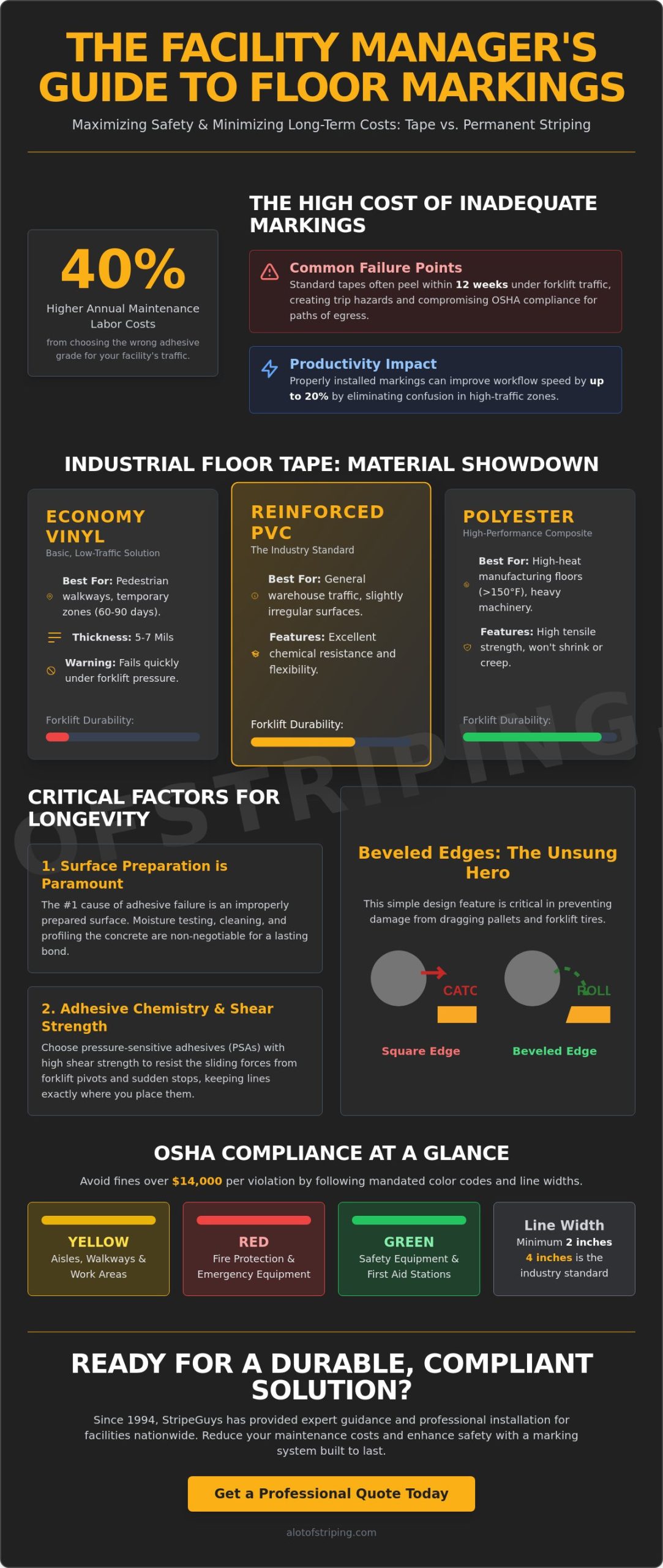
Most facility managers spend 40% more on annual maintenance labor simply because they chose the wrong adhesive grade for their specific traffic patterns. You’ve likely seen high-traffic zones where industrial floor tape starts peeling or lifting within 12 weeks, creating trip hazards and a disorganized professional image. It’s frustrating to watch a 5,000-pound forklift tear up markings that were supposed to secure your facility, especially when you’re trying to maintain 100% OSHA compliance across your paths of egress (clear exit routes).
At StripeGuys, we’ve navigated the complexities of industrial environments since 1994, focusing on safety and functional outcomes that respect your budget. This guide will help you master the technical specifications of marking materials and determine exactly when to choose tape versus permanent striping for your concrete surfaces. We’ll examine the physical realities of heavy machinery and provide a clear framework for reducing your long-term labor costs while keeping your team safe.
Key Takeaways
- Identify how to properly define paths of egress and hazardous zones to maintain a safe, compliant warehouse environment.
- Compare the durability of economy vinyl against armor-coated industrial floor tape to prevent damage from heavy forklift traffic.
- Analyze the 24-month Total Cost of Ownership (TCO) to decide between flexible tape systems and permanent epoxy striping.
- Discover why surface preparation and moisture testing are the most critical factors in preventing adhesive failure and ensuring long-term bond strength.
- Recognize the specific operational milestones that signal it is time to partner with a professional contractor for nationwide facility marking.
What is Industrial Floor Tape and Why is it Critical for Safety?
Industrial floor tape is a high-durability adhesive marking system engineered specifically for the rigors of heavy-duty warehouse environments. To understand What is Industrial Floor Tape, facility managers must distinguish it from the thin vinyl rolls found in retail stores. Standard vinyl fails almost immediately under the 10,000-pound pressure of a loaded forklift, whereas reinforced PVC or composite materials offer the structural integrity required for long-term use. Since 1994, StripeGuys has utilized these high-performance materials to define paths of egress (the continuous and unobstructed way of exit travel) and hazardous zones. This clarity is the foundation of a safe workplace.
Operational efficiency in a 500,000-square-foot logistics hub relies on immediate visual recognition. Properly installed markings can improve workflow speed by 20% by eliminating confusion during peak hours. By creating clear boundaries for pallet storage and pedestrian walkways, facilities reduce the logistical stress on supervisors. We prioritize the safety, quality, and communication triad to ensure your floor plan translates into a functional reality that respects both your timeline and your budget. This professional approach ensures that industrial floor tape serves as a reliable guide for your entire workforce.
OSHA Requirements for Floor Marking
OSHA regulations require that floor marking lines be at least 2 inches wide to ensure visibility, though 4-inch lines are the industry standard for most traffic lanes. Consistent color coding is not optional; it’s a regulatory necessity. Red identifies fire protection equipment, yellow marks aisles and work areas, and green marks first aid locations. Properly marked floors prevent costly safety citations, which can reach over $14,000 for a single serious violation during a surprise inspection. Our experience over nearly three decades helps us guide clients through these specific requirements to ensure total compliance.
The Mechanics of Industrial Adhesives
The longevity of industrial floor tape depends on its adhesive chemistry. We typically see a choice between pressure-sensitive adhesives (PSA), which bond tighter over time, and heavy-duty rubber-based agents. These tapes feature a low profile design to prevent them from becoming a tripping hazard or being peeled up by the sharp edge of a pallet. Shear strength is the ability of an adhesive to resist the sliding force applied by heavy machinery during sudden stops or sharp turns. Choosing a tape with high shear strength ensures the marking stays exactly where it was placed, even in high-traffic loading docks.
Comparing Tape Materials: From Vinyl to Heavy-Duty Composites
Selecting the right industrial floor tape requires more than just picking a high-visibility color. The physical demands of a 24-hour distribution center differ significantly from a small assembly shop. Performance is dictated by the chemical composition of the adhesive and the structural integrity of the carrier material. Since 1994, we’ve seen facility managers struggle with tape that peels within weeks because the material didn’t match the traffic load. Choosing the wrong substrate leads to adhesive transfer and constant maintenance cycles that disrupt production.
PVC vs. Polyester vs. Vinyl
PVC serves as the industry standard for general warehouse traffic. It provides excellent chemical resistance and flexibility, allowing it to bond to slightly irregular concrete surfaces. Vinyl is a thinner, economy-grade option, typically 5 to 7 mils thick. It’s best for low-traffic pedestrian areas or temporary staging zones that change every 60 to 90 days. For manufacturing floors with high-heat exposure, polyester is the superior choice. It offers higher tensile strength and won’t shrink or “creep” when exposed to temperatures exceeding 150 degrees Fahrenheit, ensuring lines stay straight even in demanding environments.
Beveled Edges and Low-Profile Designs
In environments where 15,000-pound forklifts operate, the edge of the tape is the primary failure point. Standard square-edge tapes often catch on forklift tires or dragging pallets, leading to immediate tearing. Beveled edges solve this by creating a ramped profile that allows wheels to roll over the tape rather than through it. This design reduces mechanical damage in high-turnover aisles where frequent pivoting occurs. We typically recommend 4-inch widths for major thoroughfares to ensure visibility, while 2-inch widths suffice for secondary boundaries. Standard 1910.22 of the OSHA regulations requires permanent aisles and passageways to be clearly marked, making material durability a legal necessity as much as a logistical one.
Thickness, measured in mils, isn’t the only indicator of performance. A 50-mil tape might seem durable, but if the adhesive is poor, it’ll fail faster than a 30-mil composite with a recessed adhesive channel. Specialty options also include photoluminescent strips for emergency paths of egress and anti-slip textures for moisture-prone areas. Our approach focuses on the safety, quality, and communication triad to ensure your floor marking lasts for years, not months. If you need help determining which industrial floor tape material fits your specific workflow, you can text us directly for a professional recommendation.
Durability Reality Check: Tape vs. Paint vs. Epoxy Striping
Facility managers often choose industrial floor tape because the upfront material cost appears lower on a purchase order. This is a common misconception that ignores the Total Cost of Ownership (TCO) over a standard 24-month facility cycle. While a roll of tape is inexpensive, the labor required for its fifth replacement is not. In high-traffic zones, tape typically requires full replacement every 4 to 6 months. By the end of the second year, you have likely paid for the materials four times and lost dozens of man-hours to the tedious process of scraping old adhesive and reapplying new strips.
Environmental factors frequently accelerate this failure. High humidity levels or concrete outgassing (the natural release of moisture vapor through the slab) can cause industrial floor tape to bubble and lose its grip within weeks. If your facility handles chemicals or experiences frequent oil spills, the liquids eventually seep under the edges, dissolving the bond entirely. Maintaining OSHA floor marking compliance becomes a constant struggle when your safety boundaries are peeling. If you find your team patching more than 15% of your lines every quarter, it is time to invest in permanent epoxy line painting.
The Forklift Factor
A standard industrial forklift weighs approximately 9,000 pounds before it even picks up a pallet. When a driver performs a skid-steer (pivoting the tires while the vehicle is stationary), the lateral force exerts massive pressure that exceeds the shear strength of any adhesive. In loading docks with 20 or more daily shipments, tape edges usually begin to flag or “fish-mouth” within 30 days of application. Our team prevents this by using diamond grinding to profile the concrete (roughing up the smooth surface) before application. This mechanical preparation allows the epoxy to bite into the open pores of the slab, creating a permanent bond that survives heavy equipment traffic for years rather than months.
Maintenance and Cleanliness
Tape creates a physical lip on the floor that leads to “adhesive creep,” which is the migration of glue from under the tape edges. This sticky residue attracts dust, pallet wood splinters, and floor dirt, resulting in a dark, unsightly border around your safety lines. Industrial floor scrubbers often exacerbate the problem; the aggressive action of cylindrical brushes can catch a loose edge and peel back several feet of tape in a single pass. Epoxy lines provide a monolithic surface that sits flush with the floor, allowing brushes to glide over without causing damage. In food-grade facilities, epoxy lines offer a superior sanitary profile because they lack the recessed edges where bacteria and organic matter accumulate. Since 1994, we have helped facilities transition to epoxy to ensure their paths of egress remain clean, visible, and professional.
Professional Installation: The Secret is Surface Preparation
Industrial floor tape doesn’t fail because of the adhesive; it fails because of the floor. Industry data confirms that 90% of tape failures result from inadequate surface preparation. At StripeGuys, we’ve refined our prep process since 1994 to ensure every installation withstands heavy traffic. You can’t just sweep the floor and expect 50-mil industrial floor tape to survive 10,000-pound forklift impacts. A professional install requires a deep understanding of concrete chemistry.
We begin with concrete moisture testing. If the slab is off-gassing or holds high moisture levels, the adhesive will bubble and delaminate within weeks. Our cleaning protocols move beyond basic sweeping to intensive chemical degreasing. This process removes embedded oils, pallet dust, and tire marks that create a microscopic barrier between the tape and the substrate. We also prioritize Floor Profiling (roughing up the smooth surface) to ensure the surface texture matches the adhesive requirements. Without the correct Concrete Surface Profile (CSP), the tape cannot achieve a mechanical bond.
Removing Old Markings
Successful installation requires a pristine substrate. We don’t just pull up old tape; we use specialized solvents to remove every trace of adhesive residue. If the floor has existing failed paint, we utilize diamond grinding or shot blasting. These mechanical methods strip the concrete back to a “clean and dry” state. This level of aggression is necessary for maximum adhesive wet-out, which is the physical process where the glue flows into the microscopic pores of the concrete to create a permanent anchor.
Application Best Practices
Our team uses the Tamper Cart method to ensure long-term durability. Pressure-sensitive adhesives require a minimum of 150 pounds of vertical weight to activate the bonding agents. Simply walking on the tape isn’t enough. We also pay strict attention to butt-joints and overlaps. If joints aren’t cut with precision, they create “flagging” or lifting points that snag on pallet drags. Environmental factors are equally critical. Standard industrial floor tape fails in cold-storage facilities because the adhesive freezes and cracks at 32 degrees Fahrenheit. For these environments, we use specialized freezer tape designed to maintain flexibility and bond strength down to -10 degrees.
When to Call a Professional Contractor for Your Facility
Deciding between industrial floor tape and a permanent epoxy system often depends on the scale of your operation and the intensity of your daily traffic. While tape serves as an excellent solution for organizational agility, large-scale distribution centers require the structural durability of a professionally installed system. StripeGuys has operated as a leading industrial contractor since 1994, providing the technical expertise needed for complex facility layouts. We understand that a 500,000 square foot warehouse has different requirements than a small local workshop. Our team specializes in transitioning facilities from temporary markings to high-performance epoxy systems that withstand heavy forklift traffic and constant pallet dragging.
Managing multiple distribution centers across different states requires a partner with national reach and consistent standards. We provide a single point of contact for companies looking to standardize their safety protocols across every location. Our nearly three decades of experience allow us to identify potential logistical bottlenecks before they cause accidents. We don’t just apply lines; we consult on the most efficient paths of egress and traffic flow patterns to keep your personnel safe and your audits successful.
The StripeGuys Advantage
Our operations center on the “Safety, Quality, Communication” triad. This framework ensures every project meets OSHA standards while staying on schedule and within your allocated budget. We recognize that facility downtime is expensive. To prevent operational delays, our crews handle night and weekend shifts. This allows your team to maintain productivity while we perform diamond grinding (roughing up the smooth surface) or apply specialized novolac epoxy. We provide custom stenciling and complex traffic flow planning for high-profile clients who require precision across millions of square feet. Our goal is to alleviate the logistical stress of facility managers by delivering predictable, high-quality results every time.
Requesting a National Facility Assessment
Evaluating your floor condition is the first step toward a safer environment. Our experts analyze current traffic patterns and identify specific areas where industrial floor tape might be failing due to moisture or extreme friction. We provide precise linear footage estimates and technical recommendations for surface preparation. This process includes checking for old coatings that need removal and assessing the concrete’s profile. Whether you manage one site or twenty, our national assessment provides a clear roadmap for your facility upgrades. We focus on functional outcomes that prioritize your operational needs above all else.
Optimize Your Facility Safety and Efficiency
Choosing the right industrial floor tape is a functional decision that impacts your warehouse safety and long-term maintenance budget. While heavy-duty composites provide superior durability compared to standard vinyl, the real secret to longevity is professional surface preparation like diamond grinding (mechanically profiling the concrete). Since 1994, StripeGuys has specialized in providing high-durability epoxy and precision striping for large-scale commercial facilities across the country. We prioritize the safety, quality, and communication triad to ensure your paths of egress remain clear and compliant under heavy forklift traffic. Our team brings over 29 years of field experience to every project, offering nationwide coverage for facilities that require expert organization. You don’t have to manage these logistical stresses alone. We’re here to provide the seasoned expertise your facility deserves. Get a Professional Warehouse Striping Quote from StripeGuys and let’s get your project started right.
Frequently Asked Questions
Is industrial floor tape better than paint?
Industrial floor tape offers a 0-hour cure time compared to the 24 to 48 hours required for most epoxy paints. Tape eliminates the need for diamond grinding (roughing up the smooth surface) that’s mandatory for paint adhesion. While paint resists pallet dragging better, tape allows for immediate traffic and easy layout changes in 100% of cases without disrupting your operations.
How long does heavy-duty floor tape last in a warehouse?
High-quality industrial floor tape typically lasts between 3 and 5 years in moderate traffic environments. In high-traffic forklift zones, life expectancy may drop to 12 to 24 months depending on the frequency of pivot turns. Durability is tied to the thickness of the material, often measured in mils (thousandths of an inch), with 30-mil to 50-mil tapes providing the longest service life in industrial settings.
What is the OSHA color code for warehouse floors?
OSHA Standard 1910.144 identifies red and yellow as the primary colors for marking physical hazards. Yellow is the industry standard for aisle ways, traffic lanes, and work cells. Red designates fire-related hazards like extinguishers and emergency stop buttons. While OSHA doesn’t mandate a full color chart, the ANSI Z535.1 standard provides the 10-color code system most facilities use to maintain safety, quality, and communication.
Can I use industrial floor tape on unsealed concrete?
You can apply industrial floor tape to unsealed concrete if the surface is clean, dry, and free of laitance (loose concrete dust). The adhesive bonds best to smooth, power-troweled finishes rather than porous or broom-finished surfaces. We recommend a 90% surface contact rate for maximum longevity. If the concrete is excessively dusty, a primer or sealer may be necessary to prevent the adhesive from failing prematurely.
How do I remove industrial floor tape without leaving residue?
Most heavy-duty tapes feature a synthetic rubber adhesive designed to peel up in one piece without shattering or breaking. You should start by lifting a corner with a putty knife and pulling the tape at a 90-degree angle. If any adhesive remains, a citrus-based solvent or a floor scraper can remove the 5% to 10% of residue left behind. This process is significantly faster than the grinding required to remove epoxy lines.
What is beveled edge floor tape and why is it used?
Beveled edge floor tape features a tapered profile where the edges are thinner than the center of the strip. This design allows forklift tires and pallets to slide over the tape rather than catching and tearing the edge. By reducing the impact of lateral force, beveled edges increase the lifespan of the tape by 40% in high-traffic zones. It’s a specialized solution for facilities that prioritize functional outcomes and long-term durability.
Does floor tape work in cold storage or freezer environments?
Standard adhesives fail at temperatures below 40 degrees Fahrenheit, but specialized cold-storage tapes are rated for temperatures as low as -20 degrees. You must apply these tapes to a dry surface before the temperature drops or use a specific freezer-grade adhesive. Once bonded, the tape maintains its integrity in 100% of sub-zero environments, providing clear paths of egress (exit routes) without the curing issues of cold-weather epoxy.
How much does it cost to professionally stripe a warehouse versus using tape?
Professional epoxy striping typically costs between $0.75 and $2.50 per linear foot according to 2023 industry benchmarks. Industrial floor tape costs range from $1.00 to $3.00 per linear foot for the material alone. While the initial material cost of tape is often higher, it saves approximately 70% in labor and downtime costs. Since 1994, facility managers have used these figures to balance their immediate budgets against long-term operational needs.