
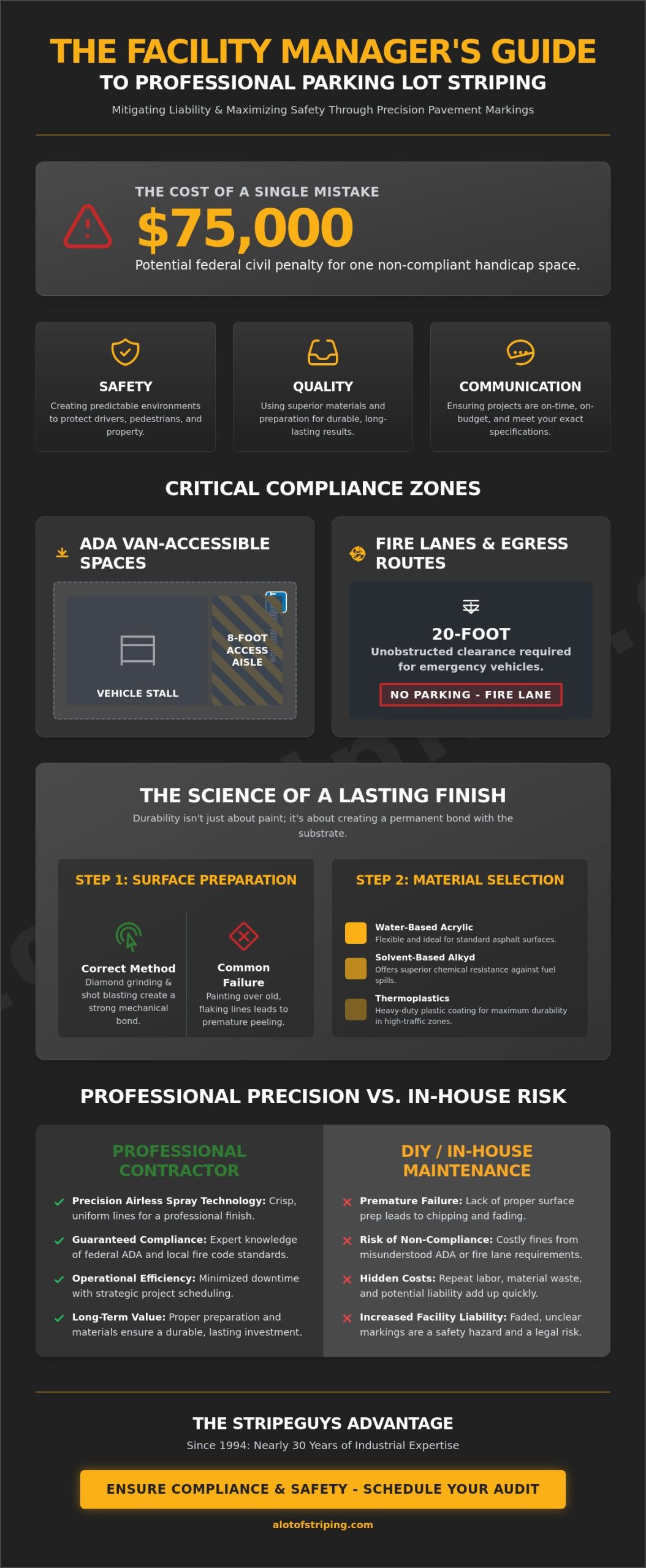
A single non-compliant handicap space can trigger a federal civil penalty of up to $75,000 for a first violation under current ADA standards. For facility managers, parking lot striping isn’t just about curb appeal; it’s a critical layer of liability protection and operational safety. You likely recognize that clear, high-visibility markings are essential for directing heavy traffic and preventing accidents on your property. Since 1994, we’ve seen how quickly a poorly executed layout can lead to logistical bottlenecks and unnecessary downtime.
We understand that your priority is a durable result that meets every legal requirement without halting your 24/7 operations. This guide provides the technical expertise you need to master material choices, such as choosing between waterborne acrylic and high-performance thermoplastics (heavy-duty plastic coatings), while ensuring your facility adheres to the latest safety codes. You’ll learn how to implement a precise traffic plan that minimizes liability and maximizes efficiency. We’ll cover everything from path of egress requirements to strategic scheduling, all rooted in our core triad of safety, quality, and communication.
Key Takeaways
- Understand how professional marking systems mitigate facility liability by improving visibility and clearly defining safety zones.
- Learn why proper surface preparation and material selection are critical for durable parking lot striping on high-traffic industrial concrete and asphalt.
- Evaluate the hidden costs of DIY maintenance compared to the precision and operational efficiency offered by professional airless spray technology.
- Master the essential steps for auditing your facility’s pavement markings to ensure accurate budgeting and adherence to strict ADA standards.
- Discover how leveraging nearly three decades of industrial experience can streamline maintenance across diverse regional distribution centers and commercial portfolios.
The Role of Parking Lot Striping in Facility Liability and Safety
Professional parking lot striping is a comprehensive traffic management system designed to protect your assets and the people who use them. Since 1994, our team has approached every project with a focus on our safety, quality, and communication triad. Property owners face substantial legal liability when faded markings lead to navigation errors. If a driver can’t see a stop bar or a directional arrow, the owner is often held responsible for the resulting collision. By following established pavement marking standards, you create a predictable environment for drivers and pedestrians. This is vital in high-traffic commercial zones where pedestrian-vehicle conflict is a constant risk. Clear boundaries keep heavy machinery away from foot traffic. Beyond safety, organized parking directly affects your bottom line. Efficient layouts can increase vehicle capacity by 10 to 15 percent, ensuring your facility operates at peak performance without the logistical stress of a congested lot.
ADA Compliance: More Than Just a Blue Square
Meeting federal requirements involves more than painting a blue square on the asphalt. The Americans with Disabilities Act (ADA) mandates specific stall widths and adjacent access aisles for van-accessible spaces. A common mistake is failing to provide the 8-foot wide access aisle required for side-loading ramps. These technical errors often lead to expensive lawsuits and Department of Justice fines, which can exceed $75,000 for a first-time violation. We focus on the precision of stenciling and the correct placement of vertical signage. Van-accessible stalls must have signs mounted at least 60 inches above the ground. This ensures visibility even when a vehicle is parked in the space, keeping your facility inclusive and legally protected.
Fire Lanes and Emergency Egress Routes
Fire marshals prioritize unobstructed access for emergency vehicles. In industrial distribution centers, maintaining clear paths of egress is a daily operational challenge. We use durable, industrial-grade coatings to mark “No Parking” zones and red curbing that stands up to heavy truck traffic. Local codes typically require fire lane markings to be placed every 20 to 25 feet to prevent unauthorized idling. Blocking a fire hydrant or a standpipe connection isn’t just a safety hazard; it’s a significant fine waiting to happen. Our parking lot striping ensures that emergency responders have the 20-foot wide clearance needed to maneuver ladder trucks during an incident. This proactive approach to facility management minimizes downtime and prioritizes life safety.
Technical Specifications: Materials and Surface Preparation
Standard traffic paint often fails on high-traffic industrial concrete because it sits on the surface rather than bonding with the substrate. For parking lot striping to withstand the 15,000-pound pressure of a loaded forklift or the constant shearing of delivery trucks, the science of adhesion must be the priority. Surface profile refers to the texture of the ground; smooth concrete acts like glass, providing no “bite” for the coating. We focus on creating a mechanical bond to prevent peeling and chipping. While water-based acrylics offer flexibility for standard asphalt, solvent-based alkyd resins provide the chemical resistance needed for outdoor environments exposed to fuel spills. We also incorporate retro-reflective glass beads into the wet paint. These specialized spheres reflect light back to a driver’s eyes, which is a critical safety feature for 24-hour facilities.
Surface Preparation: Diamond Grinding and Shot Blasting
Mechanical preparation is the foundation of every project we’ve handled since 1994. We use diamond grinding and shot blasting to remove concrete laitance (a weak, milky layer of cement dust) and existing oil contamination. Painting over old, flaking lines is a recipe for premature failure. The new layer is only as strong as the failing bond beneath it. By “roughing up the smooth surface,” we ensure the material penetrates the pores of the substrate. This level of detail is vital for maintaining ADA compliance for parking lots, as faded or illegible markings can lead to significant legal liabilities and safety hazards. Our commitment to safety, quality, and communication ensures that every square inch of the surface is ready for a long-term bond.
Material Selection: Epoxy vs. TTP-1952F
Choosing the right material depends on your facility’s specific traffic patterns and operational needs. High-solids epoxy is the industrial standard for 100% duty cycle environments. It offers maximum abrasion resistance and stands up to aggressive cleaning chemicals. For high-volume retail locations that cannot afford long closures, we specify TTP-1952F fast-dry traffic paint. This material dries to the touch in approximately 3 minutes, allowing for immediate traffic flow. Outdoor parking lot striping also requires high UV resistance to prevent the pigment from chalking or fading under direct sunlight. Since nearly three decades ago, we’ve helped managers balance these material costs with their maintenance cycles. If you’re unsure which coating fits your traffic load, you can consult with our striping experts to review your facility’s specific requirements.
Professional Contractor vs. In-House Maintenance
Facility managers often view in-house parking lot striping as a cost-saving measure. However, the financial reality usually tells a different story. DIY projects frequently incur hidden expenses through specialized equipment rental, inefficient labor, and the inevitable rework required when lines fade or peel prematurely. A manual roller or a low-pressure rental unit cannot match the bond strength of industrial-grade pressurized application. Beyond the tools, layout engineering requires a deep understanding of turning radii (typically 15 to 25 feet for standard passenger vehicles) and stall dimensions to prevent traffic bottlenecks and property damage.
Hiring a certified contractor provides a critical layer of liability transfer. By outsourcing to experts, property managers shift the burden of regulatory compliance to the service provider. This is especially vital when adhering to the 2010 ADA Standards for Accessible Design, which dictate precise stall widths, access aisle requirements, and specific signage placement. Failure to meet these federal mandates can result in significant legal exposure and fines that far exceed the cost of professional service.
The Precision of Industrial Equipment
Professional-grade airless striping machines achieve a level of detail that hand-painting cannot replicate. These units deliver crisp, 4-inch lines with zero overspray by atomizing paint at high pressure, usually exceeding 3,000 PSI. We focus on maintaining a consistent mil thickness (the measurement of paint depth) to ensure maximum wear resistance against heavy vehicle traffic. For expansive industrial facilities, we utilize laser-guided layout tools. These systems ensure perfectly straight long-line applications over hundreds of feet, eliminating the “wavy” appearance common in amateur jobs.
- Airless Technology: High-pressure application ensures the paint penetrates the asphalt pores for a superior bond.
- Consistent Mil Depth: We target 15 mils of wet film thickness to provide a durable, long-lasting finish.
- Laser Alignment: Advanced guidance systems guarantee structural symmetry across the entire lot.
Operational Continuity and Scheduling
StripeGuys recognizes that closing a lot during business hours isn’t an option for high-traffic environments. We often perform night-shift striping to ensure the facility remains fully operational while the paint dries. For multi-day projects, we use sectional phasing to manage traffic flow, closing only small portions of the lot at a time to minimize disruption. Our project management follows a strict triad of Safety, Quality, and Communication. Since 1994, this approach has allowed us to deliver durable results without disrupting the client’s daily operations. We act as a safety-conscious consultant, ensuring your facility remains organized and efficient from the first chalk line to the final coat.
Planning Your Striping Project: A Manager’s Checklist
Successful parking lot striping requires more than a bucket of paint and a clear afternoon. It demands a logistical strategy that accounts for environmental variables and operational flow. Since 1994, we’ve observed that the most durable results come from projects where the facility manager treats the pavement as a critical asset rather than a secondary concern. This planning phase is where you secure your return on investment by ensuring the application lasts for its intended lifecycle of 24 to 36 months.
The Pre-Project Site Audit
Execution begins with a physical walkthrough to identify structural liabilities. You must look for drainage issues where standing water remains for more than 48 hours after rainfall. This moisture leads to hydrostatic pressure, which causes paint peeling (the separation of the pigment from the asphalt surface). During your audit, map out paths of egress to separate high-speed forklift traffic from pedestrian walkways. If your current configuration leads to congestion, consider a full re-layout. Optimizing stall angles from 90 degrees to 60 degrees can increase total parking capacity by up to 15 percent in constrained lots.
- Linear Footage: Measure all lines to provide contractors with exact dimensions for an accurate bid.
- Stencil Inventory: Count every “No Parking,” “Fire Lane,” and ADA symbol needed to ensure compliance with local codes.
- Surface Condition: Identify areas requiring diamond grinding or concrete profiling (roughing up the smooth surface) to improve paint adhesion.
Scheduling for Minimal Disruption
Coordination is the backbone of our safety, quality, and communication triad. To achieve a clean start, schedule power washing or mechanical sweeping at least 24 hours before the striping crew arrives. This ensures the substrate is free of oils and fine dust that prevent bonding. You must set a hard “No Parking” deadline for tenants and employees. Any vehicle remaining in the work zone at the scheduled start time can cause delays that ripple through your entire operational budget.
Weather windows are the final gatekeeper. Standard waterborne traffic paint requires an ambient temperature of at least 50 degrees Fahrenheit and rising. Humidity must remain below 85 percent to facilitate proper curing. If the dew point is within 5 degrees of the air temperature, the paint will not dry, leading to “tracking” where tires pick up wet pigment and spread it across your clean pavement. After the application, perform a final inspection to verify line crispness and stencil placement before reopening the lot to traffic.
Effective planning eliminates the guesswork that leads to costly rework. If you are ready to organize your facility with precision, contact StripeGuys for a professional site evaluation.
The StripeGuys Advantage: Nearly Three Decades of Expertise
Choosing a contractor for parking lot striping involves more than comparing basic quotes. It requires finding a partner who understands the liability risks associated with poor visibility and non-compliant markings. StripeGuys isn’t a newcomer to this field. Since 1994, our team has focused on high-stakes industrial environments where a simple coat of paint isn’t enough to withstand daily operations. We operate as safety-conscious consultants rather than basic line painters. This distinction matters because facility managers need more than aesthetics; they need a partner who understands paths of egress (clear exit routes) and local ADA standards. We provide the expertise required to manage complex projects across diverse portfolios, ensuring every line serves a functional purpose.
Industrial Veteran Reliability Since 1994
Our history includes 29 years of service for high-profile clients, including international airports, high-volume warehouses, and 24-hour manufacturing plants. These environments demand markings that resist the constant friction of heavy forklift tires and 80,000-pound truck traffic. We don’t just apply paint; we select specialized materials like high-solids waterborne resins or durable epoxies based on your specific substrate. We provide high-durability markings that ensure facility safety and regulatory compliance. Our approach is built on the triad of safety, quality, and communication, ensuring that every project meets industrial standards. We prioritize functional outcomes that protect your personnel and your budget. You can expect:
- Precision application that adheres to strict blueprints and safety codes.
- Materials tested for high-traffic durability in industrial zones.
- Consultative site walks to identify potential safety gaps before we start.
- Expert surface preparation, including diamond grinding (mechanically roughing the surface) to ensure maximum paint adhesion.
Ready to Secure Your Facility?
Managing a national portfolio requires consistency across every location, regardless of geography. Our nationwide branch network allows us to provide uniform results for regional distribution centers from coast to coast. We handle the entire logistical load, from the initial removal of failing lines to the final parking lot striping application. Our commitment to transparency means you have direct access to our team. We offer 24/7 availability because we know industrial facilities don’t stop moving at 5:00 PM. We work during your slowest shifts to minimize operational downtime and keep your facility running. Our team focuses on clear boundaries and clean lines to keep your traffic flowing predictably. Contact StripeGuys today for a professional consultation to secure your facility’s safety and long-term efficiency.
Protect Your Operations with Industrial Precision
Effective parking lot striping isn’t just about aesthetics; it’s a vital safety component that minimizes liability risks and maintains site compliance. Since 1994, StripeGuys has served as a dependable industrial veteran, specializing in the complex needs of high-profile distribution and logistics hubs. We utilize specialized equipment and technical surface preparation to ensure your facility’s markings withstand constant heavy-vehicle traffic. Our national coverage means we’re ready to deploy the safety, quality, and communication triad to any location across the country. You’ll get clear paths of egress and durable boundaries that keep your team safe and your operations efficient. It’s time to trade logistical stress for professional reliability. We’ve spent nearly three decades refining our process so you don’t have to worry about the details. Get a Professional Striping Quote from StripeGuys and see why we’ve been the trusted choice for industrial leaders. We’re ready to help you organize your facility with the authority and expertise your brand deserves.
While professional pavement markings secure your physical location, ensuring your service fleet also reflects your brand’s authority is a smart business move; for high-quality commercial vehicle graphics, click here.
Frequently Asked Questions
How long does parking lot striping take to dry before cars can drive on it?
Water-based acrylic paint typically dries to the touch in 30 minutes when the temperature is 77 degrees Fahrenheit. However, vehicles shouldn’t drive on new parking lot striping for at least 4 hours to prevent tracking and premature wear. In high-humidity environments exceeding 60 percent, we recommend a 24-hour cure period. This ensures the lines maintain their structural integrity under heavy 80,000-pound GVW truck loads.
How often should a commercial parking lot be re-striped?
Commercial parking lots require re-striping every 18 to 24 months depending on daily vehicle counts. High-traffic facilities with more than 500 daily entries often see a 25 percent visibility loss within the first year. Since 1994, we’ve observed that regular maintenance prevents the total degradation of paths of egress. Maintaining clear markings is a safety requirement that reduces your liability in the event of a pedestrian accident.
Is it better to use paint or thermoplastic for parking lot lines?
Thermoplastic is 4 to 5 times thicker than standard paint and lasts up to 6 years on high-volume roadways. While more expensive upfront, it provides superior reflectivity and durability for heavy-duty industrial zones. For standard parking stalls, high-solids waterborne paint is the industry standard for cost-effective compliance. We evaluate your specific pavement surface to determine if diamond grinding is necessary for maximum material adhesion.
What are the ADA requirements for parking lot stall dimensions?
The Americans with Disabilities Act (ADA) Standards for Accessible Design require car-accessible spaces to be at least 96 inches wide. Van-accessible stalls must be 132 inches wide, or 96 inches wide if they include a 96-inch wide access aisle. These 2010 standards ensure that 1 out of every 6 accessible spaces is van-ready. We’ve applied these federal regulations since 1994 to keep facilities compliant and avoid costly legal penalties.
Can you stripe over existing lines, or do they need to be removed?
You can stripe over existing lines if the old paint is still 80 percent intact and bonded to the surface. If the old markings are peeling or represent a different traffic pattern, we use diamond grinding to remove the old material. This process of concrete profiling (roughing up the smooth surface) ensures the new parking lot striping adheres directly to the substrate. Clean removal prevents “ghost lines” that confuse drivers.
What weather conditions are required for professional parking lot striping?
Professional striping requires a minimum ambient and surface temperature of 50 degrees Fahrenheit and rising. Humidity must be below 85 percent to allow the water-based carriers to evaporate properly. We don’t paint if there’s a 30 percent or higher chance of rain within 4 hours of application. Since 1994, we’ve tracked local weather patterns to schedule windows that guarantee a durable, long-lasting finish for our clients.
How does parking lot striping improve warehouse safety and traffic flow?
Striping improves warehouse safety by clearly defining paths of egress and forklift zones to prevent 70 percent of common pedestrian-vehicle collisions. Organized floor markings increase operational efficiency by 15 percent by streamlining the movement of goods. We use specialized novolac epoxy or high-durability coatings to withstand the constant friction of 5,000-pound forklifts. Clear boundaries reduce logistical stress and ensure your facility meets OSHA 1910.22 safety standards.