
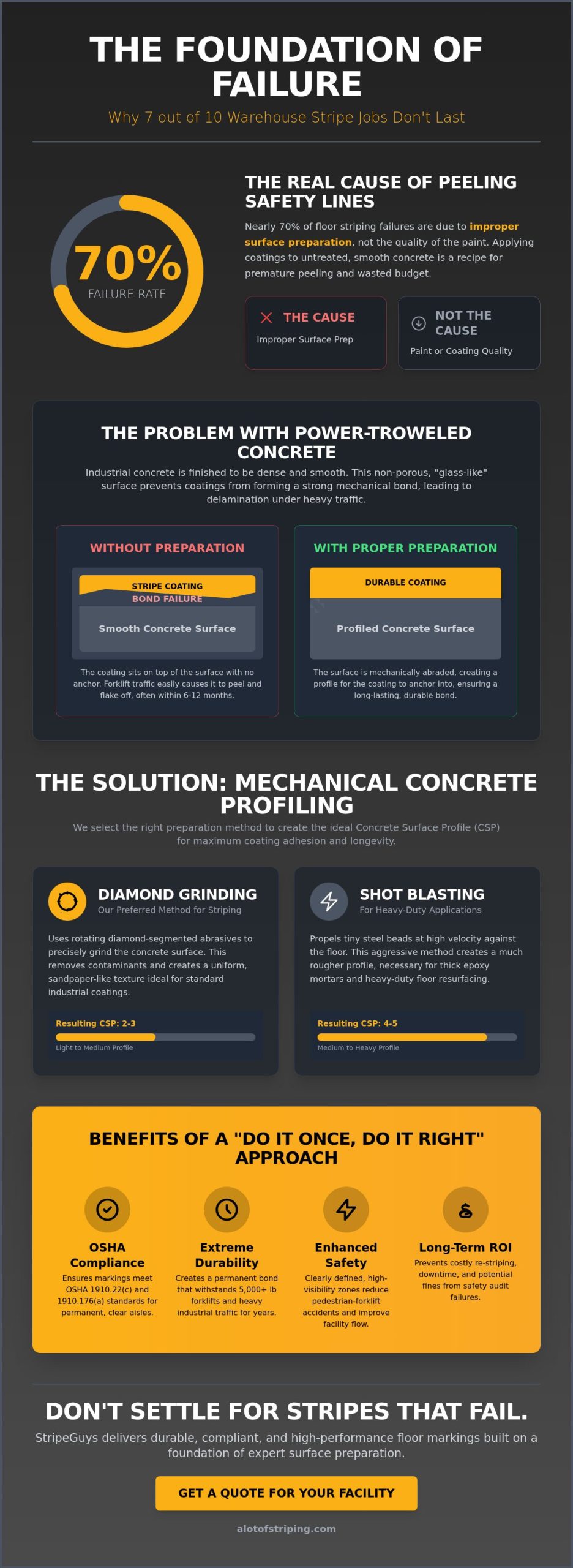
Nearly 70% of warehouse floor striping failures are caused by improper surface preparation rather than the quality of the paint itself. You’ve likely seen safety lines peel away under the weight of a 5,000-pound forklift within just six months of application. It’s a frustrating cycle that wastes your budget and puts your facility at risk during safety audits. At StripeGuys, we’ve spent nearly three decades refining the balance between safety, quality, and communication to break this cycle for our clients.
Effective warehouse floor striping transforms a chaotic floor into a synchronized logistics hub. We don’t just paint straight lines; we engineer a facility flow that minimizes travel time and maximizes safety. Since 1994, StripeGuys has helped facilities reduce traffic bottlenecks by up to 25% through strategic layout design and expert New Layout Striping. This involves creating dedicated lanes that account for the turning radius of a standard reach truck, which typically requires 8 to 11 feet of aisle width. We also plan for buffer zones. A 3-foot safety gap between forklift paths and pedestrian walkways isn’t a luxury, it’s a necessity for preventing collisions in high-decibel environments.
This guide provides a technical roadmap to achieving durable, OSHA-compliant markings that withstand industrial rigor for years. You’ll learn about essential prep methods like diamond grinding (roughing up the smooth concrete for better adhesion) and how to select specialized coatings for your specific traffic patterns. We’ll also cover logistical strategies to ensure your facility remains productive while we establish clear paths of egress and safety zones. Since 1994, our goal has been to provide the reliable expertise you need to manage your facility with confidence.
Key Takeaways
- Understand why professional warehouse floor striping serves as a vital organizational system-not just floor paint-to ensure pedestrian safety in high-traffic distribution centers.
- Learn the technical necessity of concrete profiling (the process of roughing up the surface) to prevent bond failure on smooth, power-troweled floors.
- Master “The Forklift Test” to identify whether your facility’s traffic volume requires high-performance epoxy, polyurethane, or specialized industrial coatings.
- Discover how to design a high-performance facility layout that optimizes traffic flow using custom stenciling for pallet positions and dock numbers.
- Gain insights into managing large-scale projects through the “Safety, Quality, and Communication” triad to ensure consistent results across multiple regional branches.
The Role of Warehouse Floor Striping in Industrial Safety and Efficiency
Warehouse floor striping isn’t just a matter of applying paint to concrete. It’s a functional organizational system designed to dictate the flow and safety of a facility. Since 1994, we’ve seen how clear boundaries eliminate the dangerous guesswork that leads to bottlenecks and accidents. In high-traffic environments, striping acts as the primary tool for visual management. This is a core component of Lean and 5S methodologies. It transforms a chaotic floor into a structured workspace where every square foot has a designated purpose. By defining specific zones for storage, transit, and hazardous materials, facility managers can maintain a high-performance environment that prioritizes the safety of their workforce.
Effective striping streamlines forklift traffic and optimizes staging areas to improve overall throughput. When operators know exactly where to travel and where to drop loads, the facility moves faster. This level of organization is essential for maintaining a competitive edge in modern logistics. We treat every project as a safety-conscious consultation, ensuring that the lines we lay down contribute directly to your operational goals.
Understanding OSHA and ANSI Floor Marking Standards
OSHA 1910.22(c) mandates that employers provide permanent aisles and passageways that are kept clear of obstructions. This isn’t a suggestion; it’s a requirement for operational compliance. While floor marking tapes offer a temporary solution for low-traffic areas, professional warehouse floor striping provides the durability needed for heavy machinery. Industry standards rely on specific color codes to communicate instantly with workers. Yellow marks traffic lanes and aisles. Red identifies fire-related hazards and extinguishers. Green indicates safety equipment like eyewash stations. These visual cues ensure the “Path of Egress” (the clear route to an emergency exit) remains identifiable during an emergency.
The Economic Impact of Poorly Organized Facilities
Disorganized staging areas create pallet congestion that directly impacts your bottom line. When a forklift driver spends 10 minutes navigating a cluttered floor to find a designated drop zone, that’s lost productivity. The National Safety Council reports that workplace injuries, including forklift-pedestrian accidents, result in billions of dollars in annual costs for U.S. businesses. Proper striping mitigates these risks by physically separating pedestrian zones from heavy equipment paths. We advocate for a “do it once, do it right” approach. Investing in durable, high-visibility markings provides a measurable ROI by preventing costly collisions and reducing the time spent on inventory management. It’s a strategic investment in the longevity and profitability of your facility.
Surface Preparation: The Foundation of Durable Line Marking
Most industrial floors feature power-troweled concrete. This finish is designed for density and aesthetics, but it creates a non-porous surface that rejects standard coatings. If you apply paint directly to this glass-like finish, the bond will likely fail within 6 to 12 months under heavy forklift traffic. StripeGuys prevents this through concrete profiling (the mechanical process of “roughing up” the surface) to ensure a permanent bond. Since 1994, our team has prioritized mechanical prep for every industrial project to eliminate the risk of peeling.
Surface contaminants like hydraulic oils, old wax, and curing compounds must be removed before any warehouse floor striping begins. We also perform moisture testing to identify high vapor transmission levels that could cause epoxy to blister. This technical rigor ensures compliance with OSHA standard 1910.176(a), which mandates that permanent aisles and passageways be clearly marked. Without proper preparation, these safety markings won’t withstand the daily rigors of mechanical handling equipment.
Diamond Grinding vs. Shot Blasting
We select the preparation method based on the specific coating and floor condition. Diamond grinding is our preferred method for most striping projects because it creates a precise Concrete Surface Profile (CSP) of 2 or 3. Shot blasting is reserved for heavy-duty epoxy mortars where a more aggressive CSP 4 or 5 is necessary. For food-grade facilities or sensitive environments, we utilize dustless grinding systems equipped with industrial HEPA filtration to maintain air quality and operational cleanliness.
The Process of Warehouse Line Removal
Painting over existing lines is a shortcut that leads to delamination and “ghosting,” where the old markings eventually bleed through the new layer. We use mechanical removal techniques to strip old lines down to the raw concrete. This process also includes repairing concrete pitting or structural cracks that could compromise the new application. Clean, repaired surfaces are the only way to achieve the sharp, professional boundaries your facility requires. If you need an assessment of your current markings, you can text our team directly for a professional evaluation of your floor.
Choosing the Right Materials: Epoxy, Polyurethane, and Paint
Selecting warehouse floor striping materials requires passing “The Forklift Test.” If your facility operates 24/7, standard traffic paint is a liability rather than an investment. It lacks the film thickness to withstand the 12,000 pounds of pressure exerted by a loaded reach truck. While tape offers a quick fix for temporary zones, it frequently bubbles and tears during pallet dragging, creating trip hazards that slow down your team. We prioritize permanent solutions that bond directly to the concrete substrate after diamond grinding (roughing up the smooth surface) to ensure maximum adhesion.
The choice of material depends on your specific operational environment. Referencing a warehouse floor marking color guide helps define your organizational needs, but the chemical composition determines how long those lines remain visible. Manufacturing plants dealing with coolant leaks or hydraulic fluid spills demand high-performance resins to prevent floor degradation. We evaluate every project based on four specific criteria:
- Traffic Volume: Number of forklift passes per 24-hour cycle.
- Load Weight: Maximum capacity of equipment using the aisles.
- Chemical Exposure: Presence of oils, acids, or cleaning agents.
- Surface Condition: Porosity and age of the existing concrete.
High-Performance Epoxy Line Painting
StripeGuys has provided industrial solutions since 1994, focusing on materials that outlast standard contractor-grade paints. We utilize Novolac epoxy for high-stress areas because its dense molecular structure resists aggressive chemicals and battery acid. These “high-build” coatings are essential for areas where forklifts pivot; this intense friction can strip thin paint in less than 90 days. We balance these durable installs with your production schedule, using formulas that cure in 8 to 24 hours. Our commitment to the safety, quality, and communication triad ensures your facility remains compliant without unnecessary downtime.
Specialized Coatings for Unique Environments
Cold storage facilities present unique challenges because standard epoxies won’t cure in sub-zero temperatures. We use specialized MMA (methyl methacrylate) resins that harden in 60 minutes at temperatures as low as -20 degrees Fahrenheit. For exterior loading docks, we apply UV-resistant urethanes to prevent the sun from bleaching your safety lines. In high-traffic pedestrian zones or wet processing areas, we incorporate non-slip additives (fine aggregates) to increase traction on polished concrete. This technical approach to warehouse floor striping guarantees a functional outcome that protects your staff and your long-term budget.
Designing a High-Performance Warehouse Layout
Effective warehouse floor striping transforms a chaotic floor into a synchronized logistics hub. We don’t just paint straight lines; we engineer a facility flow that minimizes travel time and maximizes safety. Since 1994, StripeGuys has helped facilities reduce traffic bottlenecks by up to 25% through strategic layout design. This involves creating dedicated lanes that account for the turning radius of a standard reach truck, which typically requires 8 to 11 feet of aisle width. We also plan for buffer zones. A 3-foot safety gap between forklift paths and pedestrian walkways isn’t a luxury, it’s a necessity for preventing collisions in high-decibel environments.
Our approach accounts for the physical realities of your daily operations. We consider how your facility might scale or shift inventory during peak seasons. By designing versatile layouts, we ensure your striping remains functional even if your pallet rack configuration changes. This foresight prevents the need for costly shot blasting (a method of removing old lines) every time your workflow evolves.
Optimizing Staging Areas and Pallet Positions
The choice between T-marking and Full Box designs depends on your specific volume. T-marks use less material and allow for slight pallet overhang, while Full Box markings provide a rigid visual boundary that enforces strict organizational discipline. We use numbered stencils to improve slotting efficiency, allowing workers to locate inventory 15% faster than unmarked floors. Safety remains the priority, so we clearly mark “No-Go Zones” in safety red. These zones ensure a 36-inch clearance around electrical panels and fire extinguishers, keeping your facility compliant with NFPA 70E standards.
Pedestrian Walkways and Crosswalks
Safe zones must be unmistakable. We utilize high-visibility “zebra stripes” for crosswalks to signal a change in right-of-way. These markings work best when integrated with physical assets like steel bollards or guardrails. By combining visual striping with physical barriers, facilities can achieve a 40% reduction in near-miss incidents. We also design these paths to accommodate future scaling. If your inventory shifts seasonally, we can implement modular striping patterns that allow for temporary staging without blocking primary paths of egress (emergency exit routes).
StripeGuys brings nearly three decades of experience to every project, ensuring your layout is durable and logical. If you’re ready to improve your facility’s safety and quality, contact our team for a professional striping consultation.
Professional Execution: Managing National Striping Projects
StripeGuys manages large-scale industrial projects through a coordinated network of regional branches that provide local expertise backed by national standards. Since 1994, our teams have navigated the high-stakes complexities of distribution centers and manufacturing plants across the United States. We approach every job site with a strict adherence to our core triad: Safety, Quality, and Communication. This framework ensures that your facility remains compliant with OSHA regulations while the markings themselves withstand the relentless friction of heavy forklift traffic.
Experience is the most critical factor when working in active industrial environments. Nearly three decades of field work allows us to anticipate common pitfalls, such as moisture vapor transmission in concrete or poor surface adhesion, before they cause project delays. We don’t just apply paint; we act as safety-conscious consultants who understand that warehouse floor striping is a vital component of your facility’s organizational logic. Our no-nonsense approach prioritizes functional outcomes, ensuring that every line and path of egress (exit route) is precise and durable.
Minimizing Operational Downtime
Maintaining high throughput is your primary goal, so we treat it as our own. We execute warehouse floor striping in distinct phases, allowing your team to move inventory and operate machinery in one zone while we prep and paint in another. Our crews utilize fast-cure materials, such as high-solids epoxies and polyaspartics, which allow for a rapid return-to-service in as little as four hours. This speed prevents the costly bottlenecks associated with traditional paint systems.
Logistics are further simplified through our night-shift capabilities. We offer 24/7 availability to align our work with your lowest traffic periods, often completing entire sections while your primary operations are paused. Communication protocols are rigorous; facility managers receive direct text updates and daily progress reports to ensure the morning shift can resume work without confusion. We bridge the gap between technical execution and practical application by coordinating every movement with your floor supervisors.
National Coverage for Multi-Site Facilities
Managing a portfolio of warehouses requires a uniform approach to safety markings to ensure employee safety regardless of the specific location. We provide a single-point-of-contact management system for our high-profile industrial clients, which eliminates the stress of vetting multiple local contractors. This centralized model guarantees that the layout and material specifications used in a Texas hub are identical to those used in a Florida facility. National Coverage is the ability to deploy expert crews to any US location with standardized quality.
- Consistency: We use standardized diamond grinding (roughing up the smooth surface) and application techniques across all sites.
- Efficiency: One contract and one point of contact for all 50 states.
- Reliability: Every crew follows the same safety protocols and quality checks established since 1994.
By maintaining these high standards nationwide, we help facility managers alleviate the logistical stress of multi-site maintenance. Our goal is to provide a dependable, long-term solution that respects your budget and your operational needs.
Secure Your Facility’s Future with Precision Engineering
Effective warehouse floor striping transforms a chaotic floor into a high-performance industrial environment. Durable results start with professional surface preparation, specifically dustless diamond grinding (roughing up the concrete for maximum adhesion). Using high-build epoxy ensures your paths of egress and forklift lanes withstand heavy traffic for years. Since 1994, StripeGuys has specialized in these technical applications to help facility managers meet safety standards without blowing the budget. We provide national coverage for large-scale distribution centers, delivering consistent results from coast to coast. Don’t settle for temporary paint that peels after a few months of use. Our team brings over 29 years of industrial experience to every project, focusing on the safety, quality, and communication triad that keeps your facility running smoothly. We understand the high stakes of industrial environments and prioritize your operational needs through every phase of execution. It’s time to invest in a layout that protects your personnel and your bottom line.
Request a Professional Warehouse Striping Quote from StripeGuys
Your facility deserves a layout that works as hard as your team does.
Frequently Asked Questions
What are the OSHA requirements for warehouse floor marking colors?
OSHA Standard 1910.144 requires red for fire-related equipment and emergency stops, while yellow is the designated color for physical hazards like tripping or falling. Although OSHA doesn’t mandate a specific color for all aisle markings, the industry standard follows the 1970 OSH Act’s General Duty Clause to keep floor lines visible and consistent. We use high-visibility safety yellow for traffic lanes to ensure 100 percent compliance during safety inspections.
How long does warehouse floor striping typically last?
Professional warehouse floor striping typically lasts between 3 to 5 years in high-traffic environments when applied with industrial-grade epoxy. Lifespan depends on surface preparation, such as diamond grinding (mechanical profiling of the concrete). Since 1994, we’ve seen that lines in low-traffic storage areas can remain legible for over 10 years. We prioritize durability by using specialized coatings that withstand 5,000-pound forklift maneuvers and constant pallet dragging.
Can you remove old warehouse lines without damaging the concrete?
We remove old lines using shot blasting or diamond grinding to ensure the concrete surface remains structurally sound. These methods strip away 1/16th of an inch of the surface material to eliminate ghosting (faint remnants of old lines) without causing deep fractures. This process creates a clean profile for new coatings to bond effectively. Our team has refined these removal techniques over nearly three decades to protect your facility’s foundation.
How long after epoxy line painting can forklifts return to the floor?
Forklifts can typically return to the floor 24 to 48 hours after the final epoxy application. While the paint may feel dry to the touch in 4 hours, it requires a full cure cycle to reach its maximum Shore D hardness rating. Operating heavy machinery too early can cause 100 percent delamination or permanent tire marks. We coordinate schedules day and night to minimize your operational downtime and ensure safety, quality, and communication.
What is the best way to mark a warehouse floor for 5S compliance?
The most effective 5S marking strategy uses a standardized color-coded system to define work cells, pallet positions, and paths of egress (emergency exit routes). We implement the 5S methodology by applying distinct colors like green for finished goods and blue for raw materials. This organization reduces waste and improves efficiency by 15 percent in typical industrial settings. Our safety-conscious consultants help you map out these boundaries for maximum facility flow.
Do you provide warehouse striping services for cold storage or freezers?
We provide specialized striping services for cold storage environments using polyaspartic or MMA (methyl methacrylate) coatings that cure in temperatures as low as -20 degrees Fahrenheit. Standard epoxies fail to bond in freezing conditions, but these rapid-cure resins allow for 100 percent adhesion without shutting down your cooling systems. Our crew has handled these high-profile projects since 1994, ensuring your freezer aisles remain organized and safe.
Is floor tape better than paint for industrial warehouses?
Industrial paint is superior to floor tape in high-traffic zones because it bonds chemically to the concrete and doesn’t peel under forklift pivoting. Tape often fails within 6 months in busy shipping docks where pallets are dragged frequently. While tape offers a temporary fix, our permanent warehouse floor striping provides a lower total cost of ownership by lasting 4 times longer than adhesive products. We focus on functional outcomes that withstand the physical realities of your environment.
How much does professional warehouse floor striping cost?
Professional striping costs are typically calculated by the linear foot and vary based on the required surface preparation and material type. According to 2023 industry benchmarks, mechanical preparation and epoxy application represent the primary investment for long-term durability. We provide transparent quotes that reflect the specific needs of your facility’s square footage. Text us directly for a precise estimate that fits your maintenance budget and operational requirements.