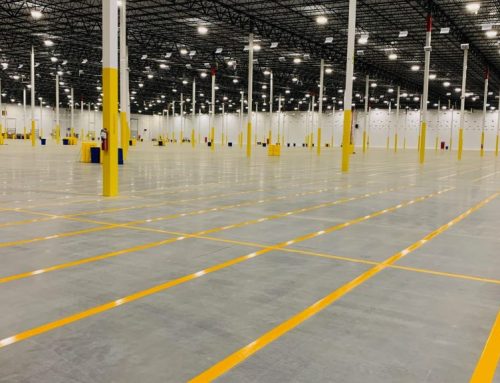
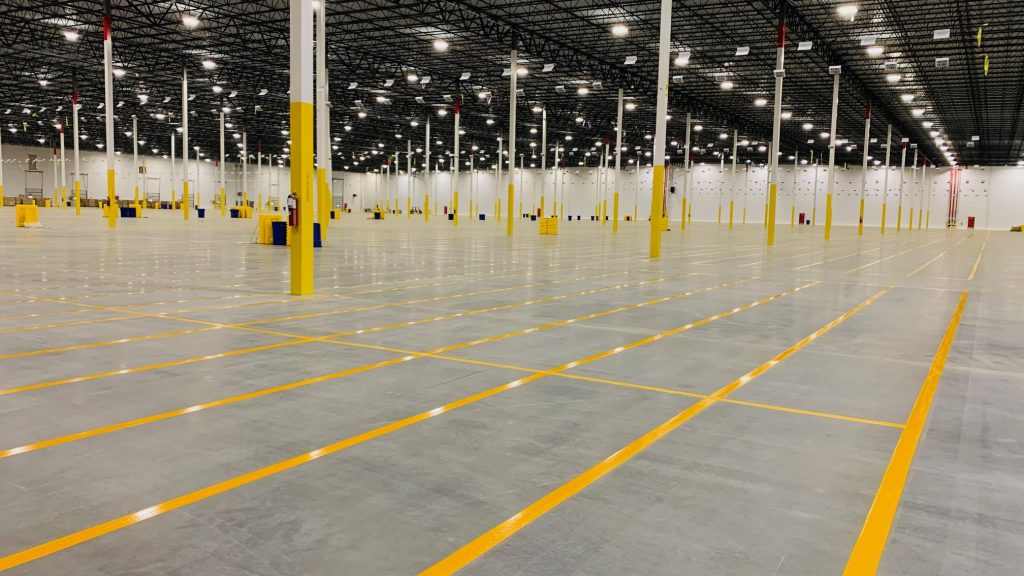
Warehouse safety markings do far more than make a floor look organized. In a busy industrial building, clear floor markings help direct forklifts, separate pedestrians, identify staging areas, and reinforce day-to-day operating rules. When markings are planned correctly, they improve traffic flow, support safer movement, and make a facility easier to manage.
At StripeGuys, we install warehouse safety markings for distribution centers, manufacturing plants, and industrial facilities that need durable, high-visibility systems. If you need a contractor for a full warehouse layout, visit our Warehouse Floor Striping Company page. If your main need is traffic-lane organization and aisle definition, review our Warehouse Line Striping Company page.
What warehouse safety markings usually include
Most safety-marking systems include forklift travel lanes, pedestrian walkways, boundary lines, pallet staging zones, no-storage areas, charging-station outlines, dock approach markings, and emergency-access paths. In many facilities, floor markings are also used to identify work cells, inspection zones, fire-equipment clearance, and intersections where extra visual control is needed.
The goal is not simply to add color to the floor. The goal is to create a marking system that employees can understand quickly and follow consistently throughout the building.
Why clear floor markings improve warehouse safety
Warehouses become risky when routes, responsibilities, and storage boundaries are left to judgment instead of visual control. Marked lanes and zones reduce uncertainty. They make it easier for operators to stay in travel paths, for pedestrians to use the right walkways, and for supervisors to see when storage or movement patterns are slipping out of compliance.
Strong safety markings also improve efficiency. When traffic and storage patterns are easier to read, teams spend less time correcting mistakes, moving obstacles, or stopping work to clarify where materials should go.
How to plan an effective warehouse marking system
An effective system starts with the real workflow of the building. That means understanding forklift routes, pedestrian crossings, loading activity, rack spacing, staging needs, and surface condition. The best layouts are designed around actual operating conditions instead of generic striping patterns.
Facilities should also think about future maintenance. Durable markings, consistent widths, repeatable colors, and clearly defined zones make it easier to expand or refresh the system over time without confusing employees.
Safety markings and material selection
Not every warehouse needs the same striping material. Some high-traffic environments need more durable coatings and stronger surface preparation. Others may use more temporary solutions in selected zones. If you are evaluating material options, compare your facility needs with our guide to epoxy vs. tape striping for warehouses.
Frequently asked questions about warehouse safety markings
What are the most important safety markings in a warehouse?
That depends on the operation, but common priorities include forklift lanes, pedestrian walkways, pallet staging zones, no-storage areas, intersections, and marked emergency-access routes.
How often should warehouse floor markings be updated?
High-traffic areas should be inspected regularly. Turn areas, dock zones, and intersections usually show wear first and often need the earliest refresh.
Do safety markings help with inspections and training?
Yes. Clear markings help reinforce facility rules visually, which supports onboarding, daily supervision, and a more organized inspection posture.
Need help improving warehouse safety markings?
If your facility needs clearer lanes, walkways, hazard zones, or storage boundaries, contact StripeGuys for a project review. You can also explore our Warehouse Floor Striping Company and Warehouse Line Striping Company pages for related service details.